Ch. 17 - Reactions at the Alpha-Carbon
Bruice - Organic Chemistry 8th Edition
Bruice8th EditionOrganic ChemistryISBN: 9780135213711당신이 사용하는 게 아니라요?교과서 변경
17장, 문제 36b

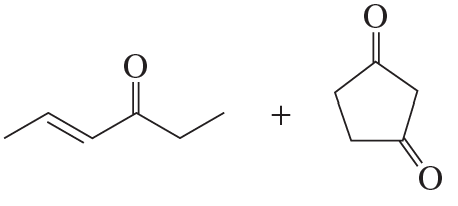
Draw the product obtained by heating each pair of ketones in a basic solution.
b. Two ketone structures are shown, indicating a reaction to form a product in a basic solution.

검증된 단계별 안내
1
Identify the reaction type: Heating ketones in a basic solution typically leads to an aldol condensation reaction. This involves the formation of a β-hydroxyketone intermediate, which can dehydrate to form an α,β-unsaturated ketone.
Determine the enolate ion formation: In a basic solution, one of the ketones will act as a nucleophile by forming an enolate ion. This occurs when the base abstracts an α-hydrogen from the ketone, generating a resonance-stabilized enolate ion.
Perform the nucleophilic attack: The enolate ion will attack the carbonyl carbon of the second ketone, forming a new carbon-carbon bond. This step results in the formation of a β-hydroxyketone intermediate.
Account for dehydration: Under heating conditions, the β-hydroxyketone intermediate undergoes dehydration (loss of water) to form an α,β-unsaturated ketone. This step involves the elimination of a hydroxide ion and a proton, leading to the formation of a double bond between the α and β carbons.
Draw the final product: Combine the structural changes from the aldol condensation reaction to depict the α,β-unsaturated ketone product. Ensure that the double bond is correctly placed between the α and β carbons, and verify the connectivity of all atoms in the molecule.

비슷한 문제에 대한 검증된 영상 답변:

이 영상 해법은 위 문제에 도움이 된다고 튜터들이 추천한 것입니다.
도움이 되었나요?

주요 개념

질문에 올바르게 답하기 위해 반드시 이해해야 하는 핵심 개념들은 다음과 같습니다.

Ketones

Ketones are organic compounds characterized by a carbonyl group (C=O) bonded to two carbon atoms. They are commonly represented by the general formula R2C=O, where R can be any alkyl or aryl group. Understanding the structure and reactivity of ketones is essential for predicting the products formed during chemical reactions, especially under different conditions such as heating or in the presence of a base.
추천 영상:
02:27
Name the ketone

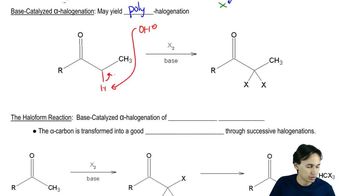
Base-Catalyzed Reactions

Base-catalyzed reactions involve the use of a base to facilitate the reaction process, often by deprotonating a molecule to form a more reactive species. In the context of ketones, heating in a basic solution can lead to various reactions, including aldol condensation, where two ketones react to form a β-hydroxy ketone, which can further dehydrate to yield an α,β-unsaturated ketone. Understanding the role of the base is crucial for predicting the reaction pathway.
추천 영상:
01:57
Base Catalyzed

Aldol Condensation

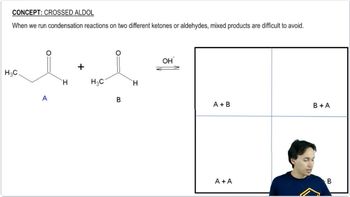
Aldol condensation is a reaction between two carbonyl compounds, typically aldehydes or ketones, in the presence of a base, leading to the formation of β-hydroxy carbonyl compounds. Upon heating, these compounds can undergo dehydration to form α,β-unsaturated carbonyl compounds. This reaction is significant in organic synthesis as it allows for the formation of larger, more complex molecules from simpler precursors, highlighting the importance of understanding reaction mechanisms.
추천 영상:
09:51
Crossed Aldol