Ch. 17 - Reactions at the Alpha-Carbon
Bruice - Organic Chemistry 8th Edition
Bruice8th EditionOrganic ChemistryISBN: 9780135213711당신이 사용하는 게 아니라요?교과서 변경
17장, 문제 40c

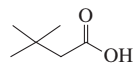
Explain why the following carboxylic acids cannot be prepared by a malonic ester synthesis:
c.

검증된 단계별 안내
1
Step 1: Understand the malonic ester synthesis process. Malonic ester synthesis is a method used to prepare carboxylic acids by alkylating malonic ester (diethyl malonate) and then hydrolyzing and decarboxylating the product. The key requirement is that the alkylation step must occur at a position where the malonic ester can form a stable intermediate.
Step 2: Analyze the structure of the given carboxylic acid. The carboxylic acid shown has a cyclopentyl group attached to a carbon adjacent to the carboxylic acid functional group. This structure suggests that the alkylation step would involve introducing a cyclopentyl group.
Step 3: Consider steric hindrance in the alkylation step. The cyclopentyl group is bulky, and introducing it via alkylation of malonic ester would be sterically hindered. This makes the reaction less likely to proceed efficiently.
Step 4: Evaluate the stability of intermediates. During malonic ester synthesis, the intermediate formed after alkylation must be stable enough to undergo hydrolysis and decarboxylation. The bulky cyclopentyl group may destabilize the intermediate, preventing successful synthesis.
Step 5: Conclude why malonic ester synthesis is not suitable. Due to steric hindrance and potential instability of intermediates, the given carboxylic acid cannot be prepared using malonic ester synthesis.

비슷한 문제에 대한 검증된 영상 답변:

이 영상 해법은 위 문제에 도움이 된다고 튜터들이 추천한 것입니다.
영상 길이:
3m
도움이 되었나요?

주요 개념

질문에 올바르게 답하기 위해 반드시 이해해야 하는 핵심 개념들은 다음과 같습니다.

Malonic Ester Synthesis

Malonic ester synthesis is a method for synthesizing carboxylic acids by alkylating malonic ester followed by hydrolysis and decarboxylation. This reaction typically requires a simple alkyl halide and results in a carboxylic acid with a two-carbon extension from the malonic ester. Understanding this process is crucial to determine why certain carboxylic acids cannot be synthesized using this method.
추천 영상:
가이드 코스
3:33
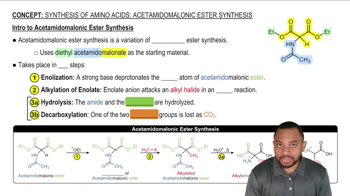
Synthesis of Amino Acids: Acetamidomalonic Ester Synthesis Concept 1

Structural Constraints

The structure of the target carboxylic acid plays a significant role in determining its feasibility for synthesis via malonic ester synthesis. If the desired acid contains functional groups or structural features that cannot be introduced through the malonic ester pathway, such as cyclic structures or specific stereochemistry, it cannot be synthesized using this method. Analyzing the structure of the acid is essential to identify these constraints.
추천 영상:
03:04
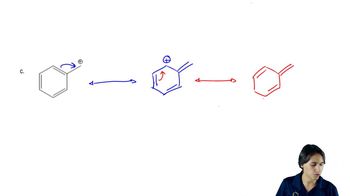
Drawing Resonance Structures

Reactivity of Intermediates

In malonic ester synthesis, the reactivity of intermediates formed during the reaction is critical. The malonic ester must be able to undergo nucleophilic substitution with an alkyl halide, and the resulting intermediate must be stable enough to proceed through hydrolysis and decarboxylation. If the intermediates formed from the target carboxylic acid are unstable or reactive in a way that leads to side reactions, the synthesis will not be successful.
추천 영상:
02:47
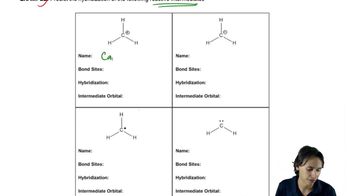
Introduction to the reactive intermediates.