Ch. 17 - Reactions at the Alpha-Carbon
Bruice - Organic Chemistry 8th Edition
Bruice8th EditionOrganic ChemistryISBN: 9780135213711당신이 사용하는 게 아니라요?교과서 변경
17장, 문제 24

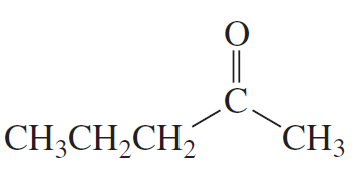
How could you prepare the following compound using a starting material that contains no more than three carbons?
Chemical structure of a ketone with a carbonyl group and two alkyl chains, illustrating enolate alkylation and acylation.

검증된 단계별 안내
1
Step 1: Analyze the target compound. The compound is a ketone with a carbonyl group (C=O) located on the second carbon of a pentane chain. This suggests that the synthesis will involve forming a ketone functional group and constructing the pentane chain.
Step 2: Choose a starting material with no more than three carbons. A suitable starting material could be ethyl bromide (C2H5Br) or propyl bromide (C3H7Br), as these are simple alkyl halides with three or fewer carbons.
Step 3: Perform a Grignard reaction. React ethyl bromide with magnesium in dry ether to form ethylmagnesium bromide (a Grignard reagent). This reagent will be used to extend the carbon chain.
Step 4: React the Grignard reagent with an appropriate carbonyl compound. For example, react ethylmagnesium bromide with propanal (CH3CH2CHO), which contains three carbons, to form a secondary alcohol intermediate. The reaction involves nucleophilic addition of the Grignard reagent to the carbonyl group.
Step 5: Oxidize the secondary alcohol to a ketone. Use an oxidizing agent such as PCC (pyridinium chlorochromate) or Jones reagent to convert the secondary alcohol into the desired ketone, completing the synthesis of the target compound.

비슷한 문제에 대한 검증된 영상 답변:

이 영상 해법은 위 문제에 도움이 된다고 튜터들이 추천한 것입니다.
영상 길이:
5m
도움이 되었나요?

주요 개념

질문에 올바르게 답하기 위해 반드시 이해해야 하는 핵심 개념들은 다음과 같습니다.

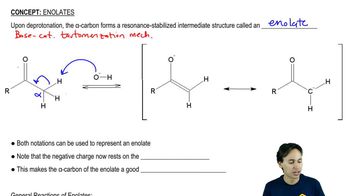
Enolate Formation

Enolates are nucleophilic species formed from the deprotonation of alpha-hydrogens in carbonyl compounds. This process is crucial for reactions such as alkylation and acylation, where the enolate acts as a nucleophile to attack electrophiles. Understanding how to generate enolates from starting materials is essential for synthesizing more complex molecules.
추천 영상:
02:26
Formation of Enolates

Alkylation Reactions

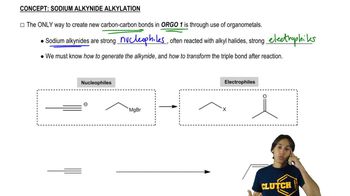
Alkylation involves the transfer of an alkyl group to a nucleophile, often using enolates derived from carbonyl compounds. This reaction allows for the construction of longer carbon chains from smaller precursors. Mastery of alkylation techniques is vital for building complex organic structures from simple starting materials.
추천 영상:
03:19
Sodium Alkynide Alkylation

Carbon Chain Length and Reactivity

The reactivity of organic compounds often depends on their carbon chain length and structure. In this context, starting materials with three or fewer carbons can be strategically chosen to ensure that the desired compound can be synthesized through enolate chemistry. Recognizing how to manipulate carbon chain length is key to effective organic synthesis.
추천 영상:
01:53
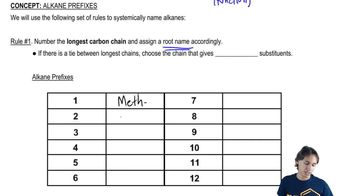
Learning Alkane Prefixes up to 12 Carbons in Length