Ch. 17 - Reactions at the Alpha-Carbon
Bruice - Organic Chemistry 8th Edition
Bruice8th EditionOrganic ChemistryISBN: 9780135213711당신이 사용하는 게 아니라요?교과서 변경
17장, 문제 73

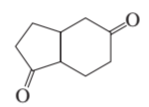
Show how the following compound can be prepared from starting materials that have no more than five carbons:
Chemical structure of a compound with five carbon atoms, illustrating a conjugate addition reaction.

검증된 단계별 안내
1
Step 1: Analyze the target compound. The structure contains a bicyclic ketone with two carbonyl groups. The compound has a total of 10 carbons, and the synthesis must start from materials with no more than five carbons.
Step 2: Identify key transformations. The compound can be synthesized using an aldol condensation reaction to form the bicyclic structure. This involves forming a new carbon-carbon bond between two smaller molecules.
Step 3: Select starting materials. Choose two molecules with no more than five carbons each that can undergo aldol condensation. For example, cyclopentanone (a five-carbon ketone) and acetaldehyde (a two-carbon aldehyde) can be used.
Step 4: Perform the aldol condensation. Under basic conditions, cyclopentanone can act as the nucleophile, and acetaldehyde can act as the electrophile. The enolate ion of cyclopentanone attacks the carbonyl carbon of acetaldehyde, forming a β-hydroxyketone intermediate.
Step 5: Complete the synthesis. Dehydrate the β-hydroxyketone intermediate to form the α,β-unsaturated ketone. Then, perform an intramolecular aldol condensation to form the bicyclic structure. Finally, oxidize the secondary alcohol to form the second ketone group.

비슷한 문제에 대한 검증된 영상 답변:

이 영상 해법은 위 문제에 도움이 된다고 튜터들이 추천한 것입니다.
영상 길이:
8m

주요 개념

질문에 올바르게 답하기 위해 반드시 이해해야 하는 핵심 개념들은 다음과 같습니다.

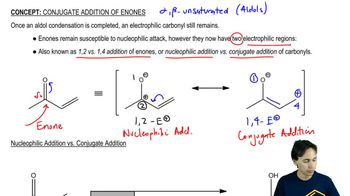
Conjugate Addition

Conjugate addition refers to the addition of a nucleophile to an α,β-unsaturated carbonyl compound. This reaction typically involves the nucleophile attacking the β-carbon, leading to the formation of a new bond. Understanding this mechanism is crucial for synthesizing compounds from simpler starting materials, as it allows for the construction of complex structures through strategic bond formation.
추천 영상:
09:23
1,2 vs 1,4 Addition

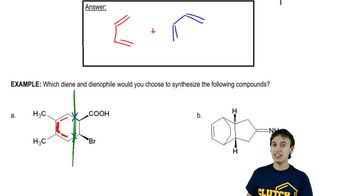
Retrosynthetic Analysis

Retrosynthetic analysis is a problem-solving technique used in organic chemistry to deconstruct a target molecule into simpler precursor structures. By identifying key functional groups and potential reaction pathways, chemists can work backward from the desired compound to determine feasible starting materials. This approach is essential for planning synthetic routes that adhere to the constraint of using starting materials with no more than five carbons.
추천 영상:
01:22
Retrosynthesis

Functional Group Interconversion

Functional group interconversion involves transforming one functional group into another through chemical reactions. This concept is vital for organic synthesis, as it allows chemists to modify starting materials to create desired intermediates or final products. Recognizing how to manipulate functional groups effectively is key to achieving the target compound from simpler carbon-based precursors.
추천 영상:
02:36
Identifying Functional Groups