Why isn’t FeBr3 used as a catalyst in the first step of the synthesis of 1,3,5-tribromobenzene?
Ch. 18 - Reactions of Benzene and Substituted Benzenes
18장, 문제 29
Explain why a diazonium group on a benzene ring cannot be used to direct an incoming substituent to the meta position.
검증된 단계별 안내1
Understand the role of the diazonium group (-N≡N⁺) on a benzene ring. The diazonium group is an electron-withdrawing group due to the positive charge on the nitrogen atom and the triple bond, which pulls electron density away from the benzene ring.
Recall the concept of electrophilic aromatic substitution (EAS). In EAS, the position of substitution is influenced by the electronic effects of substituents already present on the benzene ring. Electron-withdrawing groups typically direct incoming substituents to the meta position, while electron-donating groups direct them to the ortho and para positions.
Analyze the resonance structures of the benzene ring with the diazonium group. The diazonium group does not have resonance structures that stabilize the carbocation intermediate at the meta position during EAS. Instead, it stabilizes the carbocation intermediates at the ortho and para positions through resonance effects.
Recognize that the diazonium group is unique compared to other electron-withdrawing groups. While most electron-withdrawing groups direct substituents to the meta position, the diazonium group stabilizes the ortho and para positions due to its ability to delocalize positive charge through resonance.
Conclude that the diazonium group on a benzene ring cannot direct an incoming substituent to the meta position because it stabilizes the ortho and para positions through resonance effects, making these positions more favorable for substitution.

비슷한 문제에 대한 검증된 영상 답변:
이 영상 해법은 위 문제에 도움이 된다고 튜터들이 추천한 것입니다.
영상 길이:
4m주요 개념
질문에 올바르게 답하기 위해 반드시 이해해야 하는 핵심 개념들은 다음과 같습니다.
Diazonium Group
A diazonium group is a functional group characterized by the presence of a nitrogen atom bonded to a benzene ring, typically represented as -N2+. It is highly reactive and can participate in various electrophilic aromatic substitution reactions. However, its presence on the benzene ring influences the reactivity and orientation of incoming substituents due to its electron-withdrawing nature.
추천 영상:
Sequence Groups
Electrophilic Aromatic Substitution (EAS)
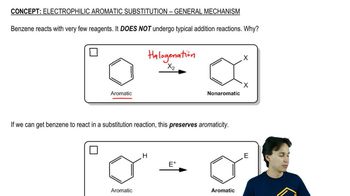
Electrophilic aromatic substitution is a fundamental reaction in organic chemistry where an electrophile replaces a hydrogen atom on an aromatic ring. The directing effects of substituents are crucial in determining the position of the incoming electrophile. Substituents can be classified as ortho/para-directing or meta-directing based on their electronic effects, which influence the stability of the intermediate carbocation formed during the reaction.
추천 영상:
EAS Review
Ortho/Para vs. Meta Directing Effects
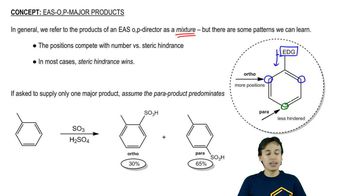
Substituents on a benzene ring can direct new substituents to specific positions based on their electronic properties. Ortho and para directing groups, such as -OH or -NH2, donate electron density, stabilizing the carbocation intermediate at these positions. In contrast, the diazonium group, being electron-withdrawing, destabilizes the carbocation at the meta position, making it unfavorable for substitution to occur there.
추천 영상:
Ortho, Para major products
관련 실천
교과서 질문
1300
views
교과서 질문
What is the major product(s) of each of the following reactions?
e. nitration of p-methoxybenzaldehyde
f. nitration of p-tert-butylmethylbenzene
1217
views
교과서 질문
What product is formed from the reaction of p-methylphenol with benzenediazonium chloride?
903
views
교과서 질문
Show how the following compounds can be synthesized from benzene:
d. m-methylnitrobenzene
1136
views
교과서 질문
In the mechanism for electrophilic aromatic substitution with a diazonium ion as the electrophile, why does nucleophilic attack occur on the terminal nitrogen of the diazonium ion rather than on the nitrogen that has the formal positive charge?
1110
views
교과서 질문
What is the major product(s) of each of the following reactions?
b. chlorination of o-benzenedicarboxylic acid
949
views