Ch. 21 - Amino Acids, Peptides, and Proteins
Bruice - Organic Chemistry 8th Edition
Bruice8th EditionOrganic ChemistryISBN: 9780135213711당신이 사용하는 게 아니라요?교과서 변경
21장, 문제 68a

α-Amino acids can be prepared by treating an aldehyde with ammonia/trace acid, followed by hydrogen cyanide, followed by acid-catalyzed hydrolysis.
a. Draw the structures of the two intermediates formed in this reaction.

검증된 단계별 안내
1
Step 1: Analyze the starting material, which is an aldehyde (benzaldehyde in this case). The reaction begins with the addition of ammonia (NH₃) in the presence of trace acid. Ammonia reacts with the aldehyde to form an imine intermediate. The imine has the general structure R-CH=NH, where R is the benzyl group.
Step 2: The imine intermediate undergoes nucleophilic addition with hydrogen cyanide (HCN). The cyanide ion (CN⁻) attacks the carbon of the imine, forming an α-aminonitrile intermediate. The structure of this intermediate includes a benzyl group attached to a carbon bonded to both an amino group (-NH₂) and a nitrile group (-C≡N).
Step 3: The α-aminonitrile intermediate is subjected to acid-catalyzed hydrolysis (H₃O⁺). During hydrolysis, the nitrile group (-C≡N) is converted into a carboxylic acid group (-COOH). This step transforms the α-aminonitrile into an α-amino acid.
Step 4: The final product is an α-amino acid, specifically phenylalanine in this case. The structure includes a benzyl group attached to a carbon bonded to both an amino group (-NH₂) and a carboxylic acid group (-COOH).
Step 5: To summarize, the two intermediates formed during the reaction are: (1) the imine intermediate (R-CH=NH) and (2) the α-aminonitrile intermediate (R-CH(NH₂)-C≡N). These intermediates are crucial for the synthesis of the α-amino acid.

비슷한 문제에 대한 검증된 영상 답변:

이 영상 해법은 위 문제에 도움이 된다고 튜터들이 추천한 것입니다.
영상 길이:
4m

주요 개념

질문에 올바르게 답하기 위해 반드시 이해해야 하는 핵심 개념들은 다음과 같습니다.

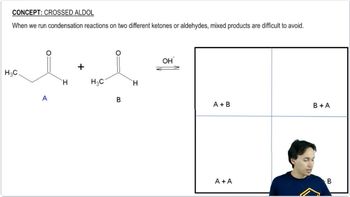
Aldol Condensation

Aldol condensation is a reaction in which an aldehyde or ketone with an alpha-hydrogen reacts with another carbonyl compound in the presence of a base or acid to form a β-hydroxy aldehyde or ketone. This reaction is crucial in the synthesis of α-amino acids, as it allows for the formation of carbon-carbon bonds, leading to the creation of complex molecules from simpler ones.
추천 영상:
09:51
Crossed Aldol

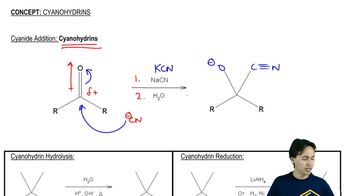
Hydrogen Cyanide Addition

The addition of hydrogen cyanide (HCN) to carbonyl compounds is a key step in the synthesis of α-amino acids. HCN acts as a nucleophile, attacking the electrophilic carbon of the carbonyl group, resulting in the formation of a cyanohydrin intermediate. This step is essential for introducing the amino group into the molecule, which is a defining feature of amino acids.
추천 영상:
03:53
Addition of Cyanide

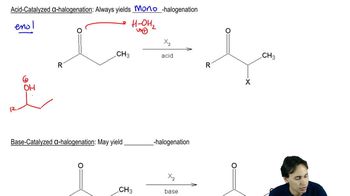
Acid-Catalyzed Hydrolysis

Acid-catalyzed hydrolysis is a reaction where a compound reacts with water in the presence of an acid, leading to the breakdown of the compound into its constituent parts. In the context of amino acid synthesis, this step converts the cyanohydrin intermediate into the corresponding α-amino acid by hydrolyzing the nitrile group to form the carboxylic acid and introducing the amino group, completing the synthesis.
추천 영상:
03:09
Acid Catalyzed
관련 실천
교과서 질문

Glycine has pKa values of 2.3 and 9.6. Do you expect the pKa values of glycylglycine to be higher or lower than these values?

1450
views

교과서 질문

After the polypeptide shown below was treated with maleic anhydride, it was hydrolyzed by trypsin. (After a polypeptide is treated with maleic anhy- dride, trypsin will cleave the polypeptide only on the C-side of arginine.)

Gly-Ala-Asp-Ala-Leu-Pro-Gly-Ile-Leu-Val-Arg-Asp-Val-Gly-Lys-Val-Glu-Val-Phe-Glu-Ala-Gly- Arg-Ala-Glu-Phe-Lys-Glu-Pro-Arg-Leu-Val-Met-Lys-Val-Glu-Gly-Arg-Pro-Val-Gly-Ala-Gly-Leu-Trp

a. After a polypeptide is treated with maleic anhydride, why does trypsin no longer cleave it on the C-side of lysine?

b. How many fragments are obtained from the polypeptide?

1181
views
교과서 질문

α-Amino acids can be prepared by treating an aldehyde with ammonia/trace acid, followed by hydrogen cyanide, followed by acid-catalyzed hydrolysis.

b. What amino acid is formed when the aldehyde that is used is 3-methylbutanal?

c. What aldehyde is needed to prepare isoleucine?

1398
views
교과서 질문

Reaction of a polypeptide with carboxypeptidase A releases Met. The polypeptide undergoes partial hydrolysis to give the following peptides. What is the sequence of the polypeptide?

1. Ser, Lys, Trp

2. Gly, His, Ala

3. Glu, Val, Ser

4. Leu, Glu, Ser

5. Met, Ala, Gly

6. Ser, Lys, Val

7. Glu, His

8. Leu, Lys, Trp

9. Lys, Ser

10. Glu, His, Val

11. Trp, Leu, Glu

12. Ala, Met

1576
views
교과서 질문

Draw the product obtained when a lysine side chain in a polypeptide reacts with maleic anhydride.

1285
views
교과서 질문

Identify the location and type of charge on the hexapeptide Lys-Ser-Asp-Cys-His-Tyr at each of the following pH values:

d. pH=12

1003
views