Ch. 21 - Amino Acids, Peptides, and Proteins
Bruice - Organic Chemistry 8th Edition
Bruice8th EditionOrganic ChemistryISBN: 9780135213711당신이 사용하는 게 아니라요?교과서 변경
21장, 문제 1a

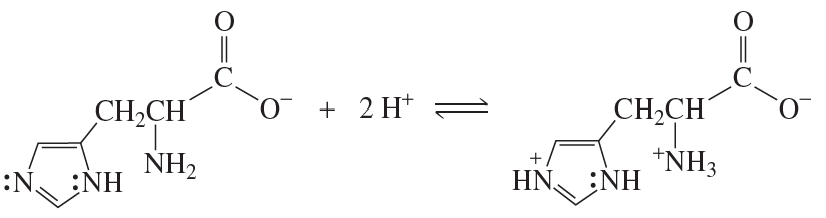
Explain why, when the imidazole ring of histidine is protonated, the double-bonded nitrogen is the nitrogen that accepts the proton.
Chemical reaction diagram illustrating the protonation of imidazole in histidine, showing nitrogen accepting a proton.

검증된 단계별 안내
1
Step 1: Begin by analyzing the structure of the imidazole ring in histidine. The imidazole ring is a five-membered aromatic ring containing two nitrogen atoms: one is a double-bonded nitrogen (sp2 hybridized), and the other is a single-bonded nitrogen (sp2 hybridized with a lone pair).
Step 2: Consider the electronic properties of the two nitrogen atoms. The double-bonded nitrogen has a higher electron density due to its involvement in the aromatic π-system, making it more nucleophilic and more likely to accept a proton.
Step 3: Evaluate the resonance stabilization of the protonated imidazole ring. When the double-bonded nitrogen is protonated, the positive charge can be delocalized across the aromatic ring through resonance, stabilizing the structure. Protonation of the single-bonded nitrogen does not allow for such delocalization.
Step 4: Examine steric factors. The double-bonded nitrogen is more accessible for protonation compared to the single-bonded nitrogen, which is involved in hydrogen bonding or interactions with other groups in the histidine side chain.
Step 5: Conclude that the double-bonded nitrogen is the preferred site for protonation due to its higher nucleophilicity, resonance stabilization upon protonation, and accessibility.

비슷한 문제에 대한 검증된 영상 답변:

이 영상 해법은 위 문제에 도움이 된다고 튜터들이 추천한 것입니다.
영상 길이:
5m

주요 개념

질문에 올바르게 답하기 위해 반드시 이해해야 하는 핵심 개념들은 다음과 같습니다.

Protonation of Nitrogen in Heterocycles

In heterocyclic compounds like imidazole, nitrogen atoms can act as proton acceptors due to their lone pairs. When protonation occurs, the nitrogen with the double bond is typically the site of protonation because it is more basic than the other nitrogen, which is part of a stable aromatic system. This preference is influenced by the electronic structure and resonance stabilization of the ring.
추천 영상:
가이드 코스
2:07
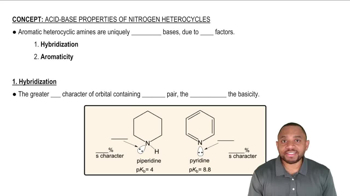
Acid-Base Properties of Nitrogen Heterocycles Concept 1

Resonance and Aromaticity

Aromatic compounds, such as imidazole, exhibit resonance, where electrons are delocalized across the ring structure. This delocalization contributes to the stability of the compound. The nitrogen that is double-bonded can stabilize the positive charge formed upon protonation through resonance, making it a more favorable site for protonation compared to other nitrogen atoms.
추천 영상:
06:43
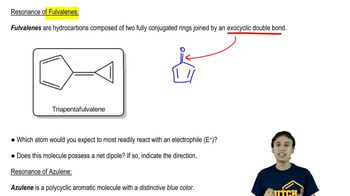
Resonance of Fulvalenes

Basicity of Nitrogen Atoms

Basicity refers to the ability of a compound to accept protons. In imidazole, the basicity of the nitrogen atoms is influenced by their hybridization and the presence of lone pairs. The double-bonded nitrogen is sp2 hybridized, which allows it to effectively donate its lone pair to accept a proton, thus increasing its basic character compared to the sp3 hybridized nitrogen.
추천 영상:
가이드 코스
1:45
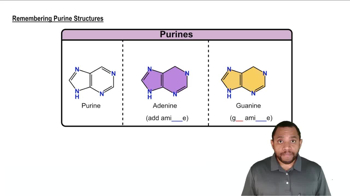
Nitrogenous Bases Concept 3