Ch. 21 - Amino Acids, Peptides, and Proteins
Bruice - Organic Chemistry 8th Edition
Bruice8th EditionOrganic ChemistryISBN: 9780135213711당신이 사용하는 게 아니라요?교과서 변경
21장, 문제 74

Dithiothreitol reacts with disulfide bridges in the same way that 2-mercaptoethanol does. With dithiothreitol, however, the equilibrium lies much more to the right. Explain.

검증된 단계별 안내
1
Dithiothreitol (DTT) contains two thiol (-SH) groups that can react with disulfide bridges (RSSR) in proteins or other molecules. The reaction involves the reduction of the disulfide bond to two thiol groups (RSH) while DTT itself forms a cyclic disulfide.
The equilibrium of this reaction lies more to the right (favoring the products) because the formation of the cyclic disulfide in DTT is highly thermodynamically favorable. This is due to the stability of the five-membered ring formed in the product.
The five-membered ring in the oxidized form of DTT is stabilized by its geometry and intramolecular interactions, which lowers the energy of the product and shifts the equilibrium toward the right.
In contrast, 2-mercaptoethanol does not form a cyclic disulfide upon oxidation. Instead, it forms a linear disulfide, which is less stable compared to the cyclic disulfide of DTT. This makes the equilibrium for 2-mercaptoethanol less favorable toward the products.
Thus, the higher thermodynamic stability of the cyclic disulfide product in DTT explains why the equilibrium lies much more to the right compared to 2-mercaptoethanol.

비슷한 문제에 대한 검증된 영상 답변:

이 영상 해법은 위 문제에 도움이 된다고 튜터들이 추천한 것입니다.
영상 길이:
6m

주요 개념

질문에 올바르게 답하기 위해 반드시 이해해야 하는 핵심 개념들은 다음과 같습니다.

Disulfide Bridges

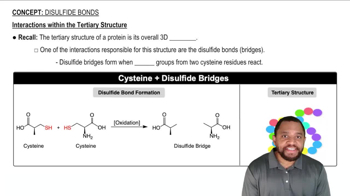
Disulfide bridges are covalent bonds formed between the sulfur atoms of two cysteine residues in proteins. These bonds play a crucial role in stabilizing the three-dimensional structure of proteins. The reduction of disulfide bridges can lead to the unfolding of proteins, affecting their function.
추천 영상:
가이드 코스
1:34
Disulfide Bonds Concept 2

Reducing Agents

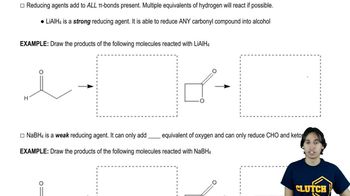
Reducing agents are substances that donate electrons to other compounds, thereby reducing their oxidation state. In the context of disulfide bridges, reducing agents like dithiothreitol (DTT) and 2-mercaptoethanol break these bonds by providing electrons, converting disulfides back to free thiols. The effectiveness of a reducing agent is often determined by its ability to shift the equilibrium of the reaction.
추천 영상:
09:28
Reducing Agents

Equilibrium in Chemical Reactions

Equilibrium in chemical reactions refers to the state where the rates of the forward and reverse reactions are equal, resulting in constant concentrations of reactants and products. In the case of DTT, its ability to shift the equilibrium further to the right indicates a stronger tendency to reduce disulfide bridges compared to 2-mercaptoethanol, making it a more effective reducing agent in biological systems.
추천 영상:
가이드 코스
3:11
Chemical Reactions of Phosphate Anhydrides Concept 1