Ch. 21 - Amino Acids, Peptides, and Proteins
Bruice - Organic Chemistry 8th Edition
Bruice8th EditionOrganic ChemistryISBN: 9780135213711당신이 사용하는 게 아니라요?교과서 변경
21장, 문제 44a

Three peptides were obtained from a trypsin digestion of two different polypeptides. In each case, indicate the possible sequences from the given data and tell what further experiment should be carried out in order to determine the primary structure of the polypeptide.
a. polypeptide I:
1. Val-Gly-Asp-Lys
2. Leu-Glu-Pro-Ala-Arg
3. Ala-Leu-Gly-Asp

검증된 단계별 안내
1
Step 1: Understand the problem. Trypsin is a proteolytic enzyme that cleaves peptide bonds specifically at the carboxyl side of lysine (Lys) and arginine (Arg) residues, unless they are followed by proline (Pro). This means the given peptides are fragments resulting from trypsin digestion of polypeptide I.
Step 2: Analyze the given peptide fragments. The three fragments provided are: (1) Val-Gly-Asp-Lys, (2) Leu-Glu-Pro-Ala-Arg, and (3) Ala-Leu-Gly-Asp. Note that fragments (1) and (2) end with Lys and Arg, respectively, which are cleavage sites for trypsin.
Step 3: Determine the possible sequence of the polypeptide. Since trypsin cleaves at Lys and Arg, the original polypeptide sequence must have had these residues at the cleavage points. To reconstruct the sequence, look for overlaps or logical connections between the fragments. For example, fragment (3) does not end with Lys or Arg, so it must be at the N-terminal or connected to another fragment.
Step 4: Propose further experiments. To confirm the primary structure of the polypeptide, perform Edman degradation on each peptide fragment to determine the sequence of amino acids. Additionally, mass spectrometry can be used to determine the molecular weight of the fragments and confirm their sequences.
Step 5: Consider overlapping peptide analysis. To further refine the sequence, perform partial digestion with another protease (e.g., chymotrypsin) to generate overlapping fragments. This will help establish the order of the fragments in the original polypeptide.

비슷한 문제에 대한 검증된 영상 답변:

이 영상 해법은 위 문제에 도움이 된다고 튜터들이 추천한 것입니다.
영상 길이:
6m
도움이 되었나요?

주요 개념

질문에 올바르게 답하기 위해 반드시 이해해야 하는 핵심 개념들은 다음과 같습니다.

Peptide Sequencing

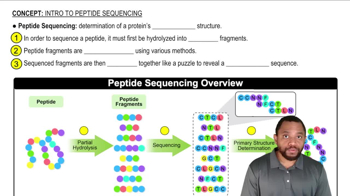
Peptide sequencing involves determining the order of amino acids in a peptide chain. Techniques such as Edman degradation or mass spectrometry can be used to identify the sequence of peptides obtained from enzymatic digestion. Understanding the sequence is crucial for deducing the structure and function of the original polypeptide.
추천 영상:
가이드 코스
1:41
Intro to Peptide Sequencing Concept 1

Trypsin Digestion

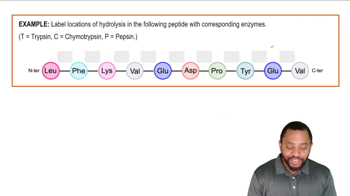
Trypsin is a proteolytic enzyme that cleaves polypeptides at specific sites, typically after lysine (Lys) and arginine (Arg) residues. This specificity allows for predictable peptide fragments to be generated from a polypeptide, which can be analyzed to infer the original sequence. Knowledge of trypsin's cleavage pattern is essential for interpreting the resulting peptide sequences.
추천 영상:
가이드 코스
3:18
Peptide Sequencing: Partial Hydrolysis Example 1

Primary Structure Determination

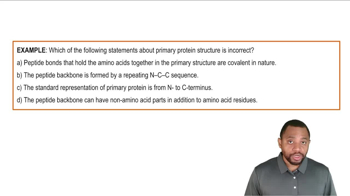
The primary structure of a polypeptide refers to its unique sequence of amino acids. To determine this structure, further experiments such as tandem mass spectrometry (MS/MS) or sequencing techniques may be employed. These methods can provide detailed information about the peptide fragments, allowing for the reconstruction of the original polypeptide sequence.
추천 영상:
가이드 코스
1:11
Primary Protein Structure Example 1