Ch. 22 - Catalysis in Organic Reactions and in Enzymatic Reactions
Bruice - Organic Chemistry 8th Edition
Bruice8th EditionOrganic ChemistryISBN: 9780135213711당신이 사용하는 게 아니라요?교과서 변경
22장, 문제 4b

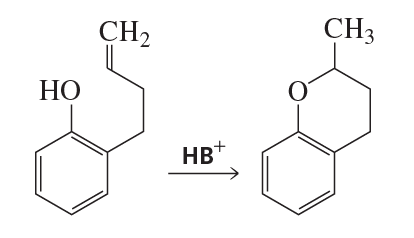
Draw the mechanism if it involves general-acid catalysis.
Chemical reaction mechanism illustrating acid-catalyzed alkoxylation, showing reactants and products with structural formulas.

검증된 단계별 안내
1
Identify the reaction type and the functional groups involved. General-acid catalysis typically involves a proton donor (acid) that facilitates the reaction by stabilizing a transition state or intermediate.
Determine the specific bond-breaking and bond-forming steps in the reaction. For example, if the reaction involves a nucleophilic attack, identify the nucleophile and electrophile.
Draw the first step of the mechanism, where the acid donates a proton to a specific atom in the substrate. Use curved arrows to show the movement of electrons. For example, if a carbonyl oxygen is protonated, show the lone pair on the oxygen attacking the proton from the acid.
Illustrate the subsequent steps of the reaction, showing how the protonation affects the reactivity of the molecule. For instance, protonation of a carbonyl group can make the carbon more electrophilic, facilitating nucleophilic attack.
Conclude the mechanism by showing the regeneration of the acid catalyst. This ensures that the catalyst is not consumed in the reaction and is available for further catalytic cycles.

비슷한 문제에 대한 검증된 영상 답변:

이 영상 해법은 위 문제에 도움이 된다고 튜터들이 추천한 것입니다.
영상 길이:
4m

주요 개념

질문에 올바르게 답하기 위해 반드시 이해해야 하는 핵심 개념들은 다음과 같습니다.

General Acid Catalysis

General acid catalysis involves the acceleration of a chemical reaction by a proton donor, which can be any species that donates a proton (H+). This process typically occurs in reactions where a nucleophile attacks an electrophile, and the acid catalyst stabilizes the transition state by protonating a leaving group or enhancing the electrophilicity of the substrate. Understanding this concept is crucial for drawing mechanisms that involve proton transfer steps.
추천 영상:
가이드 코스
2:50
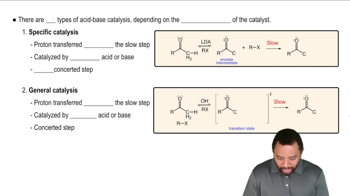
Acid-Base Catalysis Concept 3

Reaction Mechanism

A reaction mechanism is a step-by-step description of the pathway taken by reactants to convert into products. It includes all the elementary steps, intermediates, and transition states involved in the reaction. Drawing a mechanism requires knowledge of how bonds are formed and broken, as well as the role of catalysts, which is essential for accurately representing the process of general acid catalysis.
추천 영상:
02:16
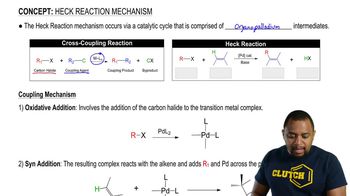
Heck Reaction Mechanism

Proton Transfer

Proton transfer is a fundamental process in acid-base chemistry where a proton (H+) is transferred from an acid to a base. In the context of general acid catalysis, this transfer is crucial as it can stabilize charged intermediates and lower the activation energy of the reaction. Understanding how and when proton transfer occurs is vital for accurately depicting the mechanism of reactions involving acid catalysis.
추천 영상:
03:
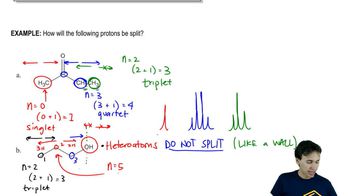
Proton Splitting