Ch. 22 - Catalysis in Organic Reactions and in Enzymatic Reactions
Bruice - Organic Chemistry 8th Edition
Bruice8th EditionOrganic ChemistryISBN: 9780135213711당신이 사용하는 게 아니라요?교과서 변경
22장, 문제 21a

Draw the pH–activity profile for an enzyme that has one catalytic group at the active site:
a. the catalytic group is a general-acid catalyst with a pKa = 5.6.

검증된 단계별 안내
1
Understand the concept of a pH–activity profile: This graph shows how the activity of an enzyme changes with pH. The activity is influenced by the ionization state of the catalytic group at the active site, which depends on its pKa value.
Identify the catalytic group as a general-acid catalyst: A general-acid catalyst donates a proton during the reaction. Its activity is highest when it is protonated, which occurs at pH values below its pKa.
Determine the ionization state of the catalytic group: At pH values below the pKa (5.6), the catalytic group will be mostly protonated and active. At pH values above the pKa, the group will be mostly deprotonated and less active.
Sketch the pH–activity profile: The enzyme activity will be high at low pH, decrease as the pH approaches the pKa (5.6), and drop significantly at higher pH values. The profile will resemble a bell-shaped curve centered around the pKa value.
Label the graph: On the x-axis, plot the pH values, and on the y-axis, plot the enzyme activity. Mark the pKa (5.6) on the graph as the point where the activity begins to decline significantly due to deprotonation of the catalytic group.

비슷한 문제에 대한 검증된 영상 답변:

이 영상 해법은 위 문제에 도움이 된다고 튜터들이 추천한 것입니다.

주요 개념

질문에 올바르게 답하기 위해 반드시 이해해야 하는 핵심 개념들은 다음과 같습니다.

pH-Activity Profile

The pH-activity profile of an enzyme illustrates how the enzyme's activity varies with changes in pH. It typically shows a bell-shaped curve, where enzyme activity is optimal at a specific pH and decreases at more acidic or basic conditions. Understanding this profile is crucial for determining the optimal conditions for enzyme function and can indicate the ionization state of active site residues.
추천 영상:
가이드 코스
4:47
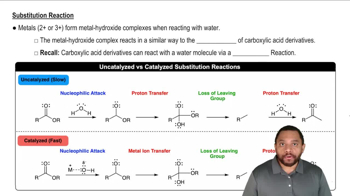
Metal Ion Catalysis: Water Activation Concept 2

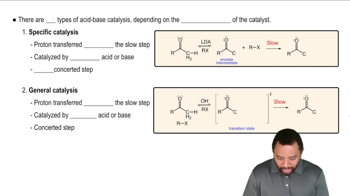
General-Acid Catalysis

General-acid catalysis involves the donation of a proton (H+) from a catalytic group to a substrate, facilitating a chemical reaction. This process is dependent on the pKa of the catalytic group, which determines its protonation state at a given pH. In this case, with a pKa of 5.6, the catalytic group will be protonated at lower pH values, enhancing its ability to donate protons and thus influence the enzyme's activity.
추천 영상:
가이드 코스
2:50
Acid-Base Catalysis Concept 3

pKa and Ionization

The pKa value of a functional group indicates the pH at which half of the molecules of that group are protonated and half are deprotonated. For the catalytic group with a pKa of 5.6, at pH values below this, the group is predominantly protonated, while above this pH, it becomes deprotonated. This transition is critical for understanding how changes in pH affect the enzyme's catalytic efficiency and overall activity.
추천 영상:
07:45
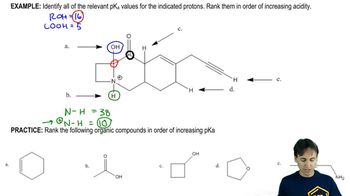
Identifying pKa values