Ch. 3 - An Introduction to Organic Compounds: Nomenclature, Physical Properties, and Structure
Bruice - Organic Chemistry 8th Edition
Bruice8th EditionOrganic ChemistryISBN: 9780135213711당신이 사용하는 게 아니라요?교과서 변경
3장, 문제 17f

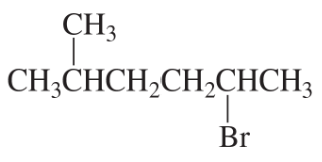
Convert the following condensed structures into skeletal structures:
f. Condensed structural formula showing a carbon chain with a bromine substituent and a methyl group.

검증된 단계별 안내
1
Identify the main carbon chain in each condensed structure. This will serve as the backbone of the skeletal structure. Count the number of carbons in the chain to ensure accuracy.
Determine the positions of substituents (e.g., alkyl groups, halogens, or functional groups) on the main chain. Note their connectivity and placement based on the condensed structure.
Draw the skeletal structure by representing carbon atoms as vertices (corners) and omitting hydrogen atoms bonded to carbons. Use lines to represent bonds between carbons.
Add any substituents to the skeletal structure at the appropriate positions. For example, if there is a methyl group (-CH₃) attached to a specific carbon, draw a line branching off from that carbon to represent the substituent.
Double-check the skeletal structure to ensure it matches the condensed structure in terms of the number of carbons, substituents, and bond types (single, double, or triple bonds).

비슷한 문제에 대한 검증된 영상 답변:

이 영상 해법은 위 문제에 도움이 된다고 튜터들이 추천한 것입니다.
영상 길이:
5m
도움이 되었나요?

주요 개념

질문에 올바르게 답하기 위해 반드시 이해해야 하는 핵심 개념들은 다음과 같습니다.

Condensed Structures

Condensed structures are a way of representing organic molecules that show the connectivity of atoms without depicting all the bonds explicitly. In these structures, atoms are grouped together to indicate how they are connected, often omitting hydrogen atoms attached to carbons for simplicity. Understanding condensed structures is essential for converting them into skeletal structures, as it requires recognizing the molecular framework and functional groups present.
추천 영상:
06:06
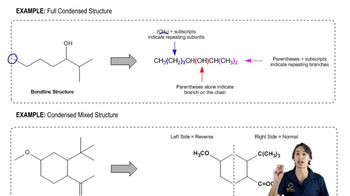
How to interpret condensed structures.

Skeletal Structures

Skeletal structures, also known as line-angle formulas, are a simplified representation of organic molecules where carbon atoms are represented by vertices and hydrogen atoms are implied. In this format, each vertex represents a carbon atom, and the lines between them represent bonds. This method allows chemists to visualize complex molecules more easily, focusing on the overall shape and connectivity rather than individual atoms.
추천 영상:
04:03
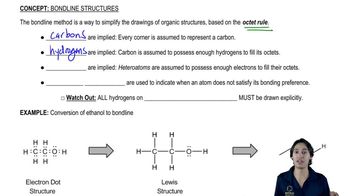
How bondline is different from Lewis Structures.

Functional Groups

Functional groups are specific groups of atoms within molecules that are responsible for the characteristic chemical reactions of those molecules. They determine the properties and reactivity of organic compounds. Recognizing functional groups in condensed structures is crucial for accurately converting them to skeletal structures, as these groups often dictate how the molecule will behave in chemical reactions.
추천 영상:
02:36
Identifying Functional Groups