Ch. 3 - An Introduction to Organic Compounds: Nomenclature, Physical Properties, and Structure
Bruice - Organic Chemistry 8th Edition
Bruice8th EditionOrganic ChemistryISBN: 9780135213711당신이 사용하는 게 아니라요?교과서 변경
3장, 문제 12f

Which isomers contain a tert-butyl group?

검증된 단계별 안내
1
Step 1: Understand the structure of a tert-butyl group. A tert-butyl group is a branched alkyl group with the formula (CH₃)₃C-. It consists of a central carbon atom bonded to three methyl groups and one other group.
Step 2: Analyze each isomer in the image to identify the presence of a tert-butyl group. Look for a central carbon atom bonded to three methyl groups.
Step 3: Examine Isomer 6. It contains a central carbon atom bonded to three methyl groups, which is characteristic of a tert-butyl group.
Step 4: Examine Isomer 11. It also contains a central carbon atom bonded to three methyl groups, indicating the presence of a tert-butyl group.
Step 5: Conclude that Isomers 6 and 11 contain a tert-butyl group based on their structural features.

비슷한 문제에 대한 검증된 영상 답변:

이 영상 해법은 위 문제에 도움이 된다고 튜터들이 추천한 것입니다.
영상 길이:
57s

주요 개념

질문에 올바르게 답하기 위해 반드시 이해해야 하는 핵심 개념들은 다음과 같습니다.

Tert-butyl group

The tert-butyl group is a branched alkyl group derived from butane, characterized by the structure -C(CH3)3. It consists of a central carbon atom bonded to three methyl groups and one other carbon chain. This group is commonly encountered in organic chemistry and is significant in determining the properties and reactivity of molecules.
추천 영상:
05:49
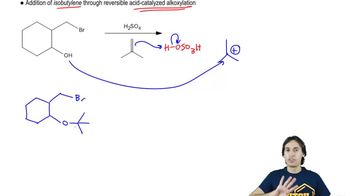
Mechanism of t-Butyl Ether Protecting Groups.

Isomerism

Isomerism refers to the phenomenon where two or more compounds have the same molecular formula but different structural arrangements or spatial orientations. In organic chemistry, isomers can be classified into structural isomers, which differ in the connectivity of atoms, and stereoisomers, which differ in the spatial arrangement of atoms. Understanding isomerism is crucial for identifying and categorizing organic compounds.
추천 영상:
06:47
Monosaccharides - D and L Isomerism

Structural representation

Structural representation in organic chemistry visually depicts the arrangement of atoms within a molecule. It includes line-angle formulas, which simplify the representation of carbon chains and functional groups. Analyzing structural representations helps chemists identify functional groups, isomers, and the overall molecular architecture, which is essential for understanding chemical behavior and reactivity.
추천 영상:
05:09
Representations of L-Configuration