Ch. 3 - An Introduction to Organic Compounds: Nomenclature, Physical Properties, and Structure
Bruice - Organic Chemistry 8th Edition
Bruice8th EditionOrganic ChemistryISBN: 9780135213711당신이 사용하는 게 아니라요?교과서 변경
3장, 문제 25

Write condensed and skeletal structures for all the tertiary alcohols with molecular formula C6H14O and give each a systematic name.

검증된 단계별 안내
1
Step 1: Understand the problem. A tertiary alcohol is an alcohol where the hydroxyl group (-OH) is attached to a carbon atom that is itself bonded to three other carbon atoms. The molecular formula C6H14O indicates there are six carbons, 14 hydrogens, and one oxygen in the molecule.
Step 2: Begin by constructing possible carbon skeletons for a six-carbon chain that can accommodate a tertiary carbon. A tertiary carbon is a carbon atom bonded to three other carbons. Consider branching to achieve this structure.
Step 3: Place the hydroxyl group (-OH) on the tertiary carbon in each possible structure. Ensure that the placement of the -OH group results in a valid tertiary alcohol and does not violate the molecular formula C6H14O.
Step 4: Write the condensed structural formulas for each valid tertiary alcohol. For example, one possible structure could be 2-methyl-2-pentanol, which has the condensed formula CH3C(CH3)(OH)CH2CH2CH3.
Step 5: Write the skeletal structures for each tertiary alcohol. In skeletal structures, carbon atoms are represented by vertices and lines, and hydrogens attached to carbons are implied. Label the hydroxyl group explicitly. Assign systematic IUPAC names to each structure based on the longest carbon chain and the position of the -OH group.

비슷한 문제에 대한 검증된 영상 답변:

이 영상 해법은 위 문제에 도움이 된다고 튜터들이 추천한 것입니다.
영상 길이:
4m

주요 개념

질문에 올바르게 답하기 위해 반드시 이해해야 하는 핵심 개념들은 다음과 같습니다.

Tertiary Alcohols

Tertiary alcohols are organic compounds where the hydroxyl (-OH) group is attached to a carbon atom that is connected to three other carbon atoms. This structure influences their reactivity and properties, making them less likely to undergo oxidation compared to primary and secondary alcohols. Understanding the classification of alcohols is crucial for identifying and naming them correctly.
추천 영상:
가이드 코스
2:07
Tertiary Protein Structure Concept 1

Skeletal Structures

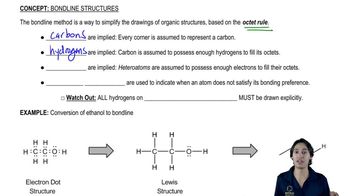
Skeletal structures, or line-angle formulas, are simplified representations of organic molecules that depict the carbon skeleton and functional groups without showing all hydrogen atoms. In these structures, each vertex represents a carbon atom, and the bonds between them are drawn as lines. This method allows for a clearer visualization of complex molecules, especially when dealing with multiple isomers.
추천 영상:
04:03
How bondline is different from Lewis Structures.

Systematic Naming (IUPAC Nomenclature)

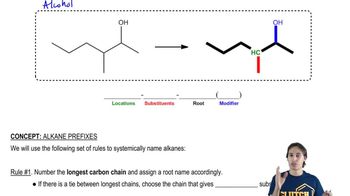
Systematic naming, governed by IUPAC rules, provides a standardized way to name organic compounds based on their structure. For tertiary alcohols, the name includes the longest carbon chain, the position of the hydroxyl group, and the suffix '-ol' to indicate the presence of the alcohol functional group. Mastery of IUPAC nomenclature is essential for accurately communicating the identity of organic compounds.
추천 영상:
03:43
The different parts of an IUPAC name