Ch. 4 - Isomers: The Arrangement of Atoms in Space
Bruice - Organic Chemistry 8th Edition
Bruice8th EditionOrganic ChemistryISBN: 9780135213711당신이 사용하는 게 아니라요?교과서 변경
4장, 문제 10b

Draw skeletal structures for each pair of isomers in Problem 7
b.

검증된 단계별 안내
1
Analyze the given structure: The compound contains a double bond (C=C) and a chlorine atom (Cl) attached to one of the carbons in the chain. This suggests the possibility of geometric (cis/trans) isomerism due to the double bond.
Understand the concept of geometric isomerism: Geometric isomers occur when there is restricted rotation around a double bond, and the substituents on the double-bonded carbons are arranged differently in space. For this compound, the chlorine atom and the ethyl group (CH2CH3) can be positioned either on the same side (cis) or opposite sides (trans) of the double bond.
Draw the skeletal structure for the cis isomer: In the cis isomer, the chlorine atom and the ethyl group are on the same side of the double bond. Represent the double bond as two parallel lines, and ensure the substituents are positioned correctly.
Draw the skeletal structure for the trans isomer: In the trans isomer, the chlorine atom and the ethyl group are on opposite sides of the double bond. Again, represent the double bond as two parallel lines, and position the substituents accordingly.
Verify the structures: Ensure that both skeletal structures maintain the correct connectivity of atoms and the correct placement of substituents relative to the double bond. Confirm that the cis and trans isomers are distinct and follow the rules of geometric isomerism.

비슷한 문제에 대한 검증된 영상 답변:

이 영상 해법은 위 문제에 도움이 된다고 튜터들이 추천한 것입니다.
영상 길이:
2m

주요 개념

질문에 올바르게 답하기 위해 반드시 이해해야 하는 핵심 개념들은 다음과 같습니다.

Isomerism

Isomerism refers to the phenomenon where two or more compounds have the same molecular formula but different structural arrangements or spatial orientations. This can lead to distinct physical and chemical properties. The two main types of isomers are structural isomers, which differ in the connectivity of atoms, and stereoisomers, which have the same connectivity but differ in the spatial arrangement of atoms.
추천 영상:
06:47
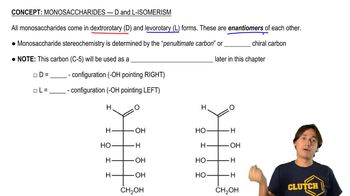
Monosaccharides - D and L Isomerism

Skeletal Structures

Skeletal structures, also known as line-angle formulas, are a simplified way of representing organic molecules. In these diagrams, carbon atoms are represented by the ends and intersections of lines, while hydrogen atoms are often omitted for clarity. This method allows chemists to visualize the molecular framework quickly, focusing on functional groups and connectivity without cluttering the diagram with hydrogen atoms.
추천 영상:
04:03
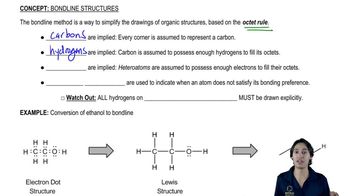
How bondline is different from Lewis Structures.

Functional Groups

Functional groups are specific groups of atoms within molecules that are responsible for the characteristic chemical reactions of those molecules. They determine the properties and reactivity of organic compounds. Common functional groups include hydroxyl (-OH), carboxyl (-COOH), and amino (-NH2) groups, and recognizing these groups is essential for understanding the behavior of isomers and their potential reactions.
추천 영상:
02:36
Identifying Functional Groups