Ch. 5 - Alkenes: Structure, Nomenclature, and an Introduction to Reactivity • Thermodynamics and Kinetics
Bruice - Organic Chemistry 8th Edition
Bruice8th EditionOrganic ChemistryISBN: 9780135213711당신이 사용하는 게 아니라요?교과서 변경
5장, 문제 47

a. Which is the most stable: 3,4-dimethyl-2-hexene, 2,3-dimethyl-2-hexene, or 4,5-dimethyl-2-hexene?
b. Which compound has the largest heat of hydrogenation?
c. Which compound has the smallest heat of hydrogenation?

검증된 단계별 안내
1
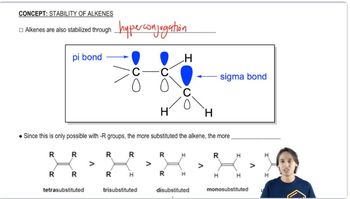
Step 1: Understand the stability of alkenes. Alkene stability is influenced by the degree of substitution of the double bond. More substituted alkenes are generally more stable due to hyperconjugation and inductive effects. Tetrasubstituted alkenes are the most stable, followed by trisubstituted, disubstituted, and monosubstituted alkenes.
Step 2: Analyze the substitution pattern of each compound. For 3,4-dimethyl-2-hexene, the double bond is between carbons 2 and 3, and it is trisubstituted. For 2,3-dimethyl-2-hexene, the double bond is between carbons 2 and 3, and it is tetrasubstituted. For 4,5-dimethyl-2-hexene, the double bond is between carbons 2 and 3, and it is disubstituted.
Step 3: Compare the stability of the compounds. Based on the substitution pattern, 2,3-dimethyl-2-hexene (tetrasubstituted) is the most stable, followed by 3,4-dimethyl-2-hexene (trisubstituted), and then 4,5-dimethyl-2-hexene (disubstituted).
Step 4: Understand the relationship between heat of hydrogenation and stability. The heat of hydrogenation is inversely related to alkene stability. More stable alkenes release less heat upon hydrogenation, while less stable alkenes release more heat.
Step 5: Determine the compounds with the largest and smallest heat of hydrogenation. The least stable compound, 4,5-dimethyl-2-hexene, will have the largest heat of hydrogenation. The most stable compound, 2,3-dimethyl-2-hexene, will have the smallest heat of hydrogenation.

비슷한 문제에 대한 검증된 영상 답변:

이 영상 해법은 위 문제에 도움이 된다고 튜터들이 추천한 것입니다.
영상 길이:
4m

주요 개념

질문에 올바르게 답하기 위해 반드시 이해해야 하는 핵심 개념들은 다음과 같습니다.

Stability of Alkenes

The stability of alkenes is influenced by the degree of substitution at the double bond. More substituted alkenes, such as tetrasubstituted or trisubstituted, are generally more stable due to hyperconjugation and the inductive effect of alkyl groups. In this context, comparing the substitution patterns of 3,4-dimethyl-2-hexene, 2,3-dimethyl-2-hexene, and 4,5-dimethyl-2-hexene will help determine which is the most stable.
추천 영상:
04:28
Understanding trends of alkene stability.

Heat of Hydrogenation

The heat of hydrogenation is a measure of the energy released when an alkene is converted to an alkane through the addition of hydrogen. A higher heat of hydrogenation indicates a less stable alkene, as more energy is required to break the double bond. Thus, analyzing the heats of hydrogenation for the given compounds will reveal which has the largest and smallest values, correlating with their stability.
추천 영상:
00:48
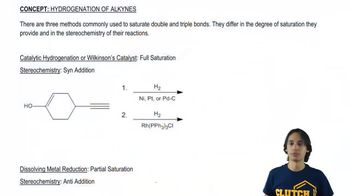
The definition of hydrogenation.

Zaitsev's Rule

Zaitsev's Rule states that in elimination reactions, the more substituted alkene is typically the major product. This principle can be applied to predict the stability of the alkenes formed from the compounds in the question. Understanding this rule aids in determining which compound will have a lower heat of hydrogenation due to its greater stability, as more substituted alkenes are favored.
추천 영상:
01:18
Defining Zaitsev’s Rule