Ch. 5 - Alkenes: Structure, Nomenclature, and an Introduction to Reactivity • Thermodynamics and Kinetics
Bruice - Organic Chemistry 8th Edition
Bruice8th EditionOrganic ChemistryISBN: 9780135213711당신이 사용하는 게 아니라요?교과서 변경
5장, 문제 51b

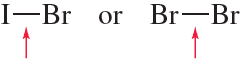
Which bond is stronger? Briefly explain why.
b. Comparison of bond strength between I-Br and Br-Br, with arrows indicating bond polarity.

검증된 단계별 안내
1
Step 1: Understand the concept of bond strength. Bond strength is determined by the bond dissociation energy, which is the energy required to break a bond in a molecule. Stronger bonds have higher bond dissociation energies.
Step 2: Consider the type of bond. Single bonds (σ bonds) are generally weaker than double bonds (σ + π bonds), and double bonds are weaker than triple bonds (σ + 2π bonds). This is because additional π bonds increase the overall bond strength.
Step 3: Analyze the atoms involved in the bond. Bonds between smaller atoms (e.g., C-H) are typically stronger than bonds between larger atoms (e.g., C-I) due to better orbital overlap.
Step 4: Consider electronegativity differences. Bonds between atoms with significant electronegativity differences (e.g., C-F) are often stronger due to increased ionic character.
Step 5: Evaluate resonance and hybridization effects. Resonance can delocalize electrons, weakening bonds, while sp-hybridized bonds (e.g., in alkynes) are stronger than sp2 (e.g., in alkenes) or sp3 (e.g., in alkanes) due to increased s-character.

비슷한 문제에 대한 검증된 영상 답변:

이 영상 해법은 위 문제에 도움이 된다고 튜터들이 추천한 것입니다.
영상 길이:
3m
도움이 되었나요?

주요 개념

질문에 올바르게 답하기 위해 반드시 이해해야 하는 핵심 개념들은 다음과 같습니다.

Bond Strength

Bond strength refers to the amount of energy required to break a bond between two atoms. It is influenced by factors such as the type of bond (single, double, or triple), the electronegativity of the atoms involved, and the bond length. Generally, shorter bonds and those involving greater overlap of atomic orbitals are stronger.
추천 영상:
06:00
Single bonds, double bonds, and triple bonds.

Types of Chemical Bonds

Chemical bonds can be categorized into ionic, covalent, and metallic bonds. Covalent bonds, formed by the sharing of electrons, can be further classified into single, double, and triple bonds, with triple bonds being the strongest due to increased electron sharing. Understanding these types helps in comparing bond strengths effectively.
추천 영상:
가이드 코스
3:11
Chemical Reactions of Phosphate Anhydrides Concept 1

Electronegativity

Electronegativity is a measure of an atom's ability to attract and hold onto electrons in a bond. Atoms with high electronegativity tend to form stronger bonds with other atoms, as they can pull shared electrons closer, resulting in a more stable bond. This concept is crucial for understanding why certain bonds are stronger than others.
추천 영상:
1:47
Electronegativity