Ch. 7 - The Reactions of Alkynes • An Introduction to Multistep Synthesis
Bruice - Organic Chemistry 8th Edition
Bruice8th EditionOrganic ChemistryISBN: 9780135213711당신이 사용하는 게 아니라요?교과서 변경
7장, 문제 33e,f

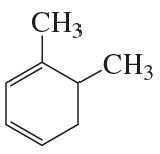
What is each compound's systematic name?
e. Skeletal structure of a benzene ring, showing its hexagonal shape with alternating double bonds.
f. Chemical structure of a benzene ring with two methyl groups attached, representing a compound for systematic naming.

검증된 단계별 안내
1
Step 1: Analyze the structure in image A. It is a six-membered ring with alternating double bonds, which is characteristic of benzene. Benzene is the simplest aromatic compound.
Step 2: For compound A, confirm that there are no substituents or additional functional groups attached to the benzene ring. This means the systematic name for compound A is simply 'benzene.'
Step 3: Analyze the structure in image B. It is a benzene ring with two substituents: one methyl group (CH₃) attached to the first carbon and another methyl group attached to the second carbon.
Step 4: Determine the numbering of the substituents in compound B. Since the substituents are adjacent, the numbering starts at one of the methyl groups and proceeds to the next carbon. This makes the substituents at positions 1 and 2.
Step 5: Combine the substituent names with the benzene ring. The systematic name for compound B is '1,2-dimethylbenzene,' which is also commonly known as 'o-xylene' (ortho-xylene).

비슷한 문제에 대한 검증된 영상 답변:

이 영상 해법은 위 문제에 도움이 된다고 튜터들이 추천한 것입니다.
영상 길이:
2m

주요 개념

질문에 올바르게 답하기 위해 반드시 이해해야 하는 핵심 개념들은 다음과 같습니다.

Benzene Structure

Benzene is a fundamental aromatic hydrocarbon characterized by its six carbon atoms arranged in a ring, with alternating double bonds. This structure allows for resonance, where the electrons are delocalized, contributing to its stability and unique chemical properties. Understanding benzene's structure is crucial for naming and identifying derivatives.
추천 영상:
09:04
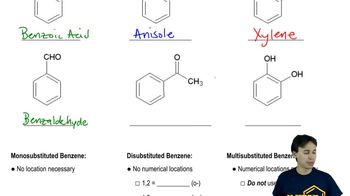
Benzene Nomenclature

Substituent Naming

In organic chemistry, substituents are atoms or groups that replace hydrogen atoms in a hydrocarbon. The systematic naming of compounds involves identifying these substituents and their positions on the parent hydrocarbon chain. For example, in compound B, the presence of methyl groups (–CH3) attached to the benzene ring influences the compound's name and classification.
추천 영상:
02:25
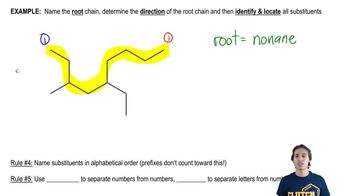
Name the longest carbon chain and substituents

IUPAC Nomenclature

The International Union of Pure and Applied Chemistry (IUPAC) provides a systematic method for naming organic compounds. This nomenclature includes rules for identifying the longest carbon chain, numbering the carbon atoms, and naming substituents based on their position. Mastery of IUPAC rules is essential for accurately determining the systematic names of compounds like those shown in the image.
추천 영상:
03:43
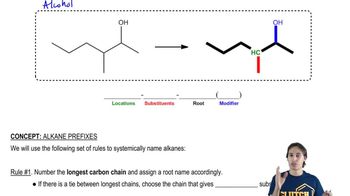
The different parts of an IUPAC name