Ch. 7 - The Reactions of Alkynes • An Introduction to Multistep Synthesis
Bruice - Organic Chemistry 8th Edition
Bruice8th EditionOrganic ChemistryISBN: 9780135213711당신이 사용하는 게 아니라요?교과서 변경
7장, 문제 26a

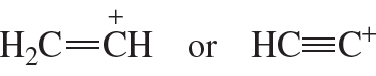
Which carbocation is more stable?
a. Comparison of two carbocations: H2C=CH+ on the left and HC≡C+ on the right, questioning stability.

검증된 단계별 안내
1
Step 1: Analyze the stability of carbocations based on their structure. Carbocation stability is influenced by factors such as hyperconjugation, resonance, and inductive effects. Generally, tertiary carbocations are more stable than secondary, which are more stable than primary carbocations.
Step 2: Examine option A. The carbocation is allylic, meaning it is adjacent to a double bond. Allylic carbocations benefit from resonance stabilization, as the positive charge can delocalize over the π-system of the double bond.
Step 3: Examine option B. The carbocation is adjacent to a triple bond. However, sp hybridized carbons are less effective at stabilizing positive charges due to their high electronegativity, making this carbocation less stable.
Step 4: Examine option C. Similar to option B, the carbocation is adjacent to a triple bond. The same reasoning applies: sp hybridized carbons do not stabilize positive charges well, so this carbocation is also less stable.
Step 5: Examine option D. The carbocation is allylic and benefits from resonance stabilization, similar to option A. However, the additional hydrogen on the central carbon in D does not significantly affect the resonance stabilization compared to A. Both A and D are likely to be more stable than B and C.

비슷한 문제에 대한 검증된 영상 답변:

이 영상 해법은 위 문제에 도움이 된다고 튜터들이 추천한 것입니다.
영상 길이:
5m

주요 개념

질문에 올바르게 답하기 위해 반드시 이해해야 하는 핵심 개념들은 다음과 같습니다.

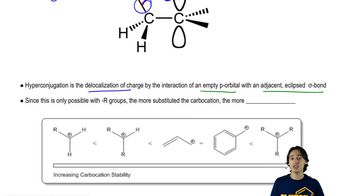
Carbocation Stability

Carbocation stability is influenced by the degree of substitution at the positively charged carbon atom. Tertiary carbocations (three alkyl groups attached) are more stable than secondary (two alkyl groups) and primary (one alkyl group) due to hyperconjugation and inductive effects, which help to disperse the positive charge.
추천 영상:
05:58
Determining Carbocation Stability

Hyperconjugation

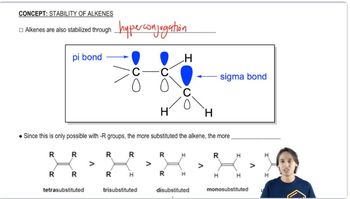
Hyperconjugation is a stabilizing interaction that occurs when the electrons in a sigma bond (C-H or C-C) interact with an adjacent empty p-orbital of a carbocation. This interaction allows for the delocalization of the positive charge, enhancing the stability of the carbocation, particularly in more substituted carbocations.
추천 영상:
04:28
Understanding trends of alkene stability.

Inductive Effect

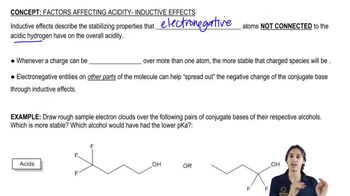
The inductive effect refers to the electron-withdrawing or electron-donating effects of substituents through sigma bonds. Alkyl groups are electron-donating, which can help stabilize a carbocation by reducing the positive charge through the inductive effect, making carbocations with more alkyl groups more stable.
추천 영상:
01:47
Understanding the Inductive Effect.