Ch. 8 - Delocalized Electrons: Their Effect on Stability, pKa, and the Products of a Reaction • Aromaticity and Electronic Effects: An Introduction to the Reactions of Benzene
Bruice - Organic Chemistry 8th Edition
Bruice8th EditionOrganic ChemistryISBN: 9780135213711당신이 사용하는 게 아니라요?교과서 변경
8장, 문제 75

Which loses a proton more readily: a methyl group bonded to cyclohexane or a methyl group bonded to benzene?

검증된 단계별 안내
1
Step 1: Analyze the structures provided in the image. Structure A shows a methyl group bonded to a benzene ring, while structure B shows a methyl group bonded to a cyclohexane ring. Benzene is aromatic, whereas cyclohexane is non-aromatic.
Step 2: Consider the acidity of the hydrogen atom attached to the methyl group in each structure. Acidity is influenced by the stability of the conjugate base formed after losing a proton. A more stable conjugate base corresponds to a more acidic proton.
Step 3: For structure A (methyl group bonded to benzene), losing a proton results in a conjugate base where the negative charge can be delocalized into the aromatic ring through resonance. This delocalization stabilizes the conjugate base.
Step 4: For structure B (methyl group bonded to cyclohexane), losing a proton results in a conjugate base where the negative charge remains localized on the carbon atom. Cyclohexane does not provide resonance stabilization, making the conjugate base less stable.
Step 5: Compare the stability of the conjugate bases. The conjugate base of structure A is more stable due to resonance stabilization in the benzene ring, making the methyl group bonded to benzene lose a proton more readily than the methyl group bonded to cyclohexane.

비슷한 문제에 대한 검증된 영상 답변:

이 영상 해법은 위 문제에 도움이 된다고 튜터들이 추천한 것입니다.
영상 길이:
3m

주요 개념

질문에 올바르게 답하기 위해 반드시 이해해야 하는 핵심 개념들은 다음과 같습니다.

Acidity and Proton Loss

Acidity refers to the ability of a compound to donate a proton (H+). The more readily a compound loses a proton, the stronger its acidity. In organic chemistry, the stability of the resulting conjugate base after proton loss is crucial in determining acidity. Factors such as electronegativity, resonance, and hybridization play significant roles in this process.
추천 영상:
03:
Proton Splitting

Resonance Stabilization

Resonance stabilization occurs when a molecule can be represented by multiple valid Lewis structures, allowing for the delocalization of electrons. In the context of acidity, if the conjugate base formed after proton loss can be stabilized by resonance, it will be more favorable for the original compound to lose a proton. This is particularly relevant when comparing the methyl group on benzene, which benefits from resonance, to that on cyclohexane, which does not.
추천 영상:
03:43
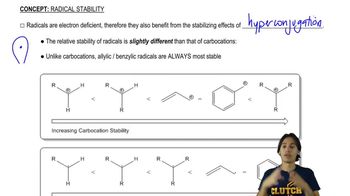
The radical stability trend.

Inductive Effect

The inductive effect refers to the electron-withdrawing or electron-donating effects of substituents through sigma bonds. In the case of the methyl group on benzene, the presence of the aromatic ring can exert an electron-withdrawing inductive effect, which can influence the acidity of the hydrogen atom. Conversely, the cyclohexane structure does not have such electron-withdrawing characteristics, making the methyl group less acidic in that context.
추천 영상:
01:47
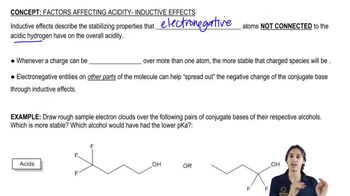
Understanding the Inductive Effect.