Ch. 8 - Delocalized Electrons: Their Effect on Stability, pKa, and the Products of a Reaction • Aromaticity and Electronic Effects: An Introduction to the Reactions of Benzene
Bruice - Organic Chemistry 8th Edition
Bruice8th EditionOrganic ChemistryISBN: 9780135213711당신이 사용하는 게 아니라요?교과서 변경
8장, 문제 4d

Which species in each pair is more stable?
d. Comparison of two conjugated intermediates with amino and hydroxyl groups attached to a central carbon atom.

검증된 단계별 안내
1
Identify the two species in the pair and determine their structures. Look for any differences in functional groups, hybridization, or resonance structures.
Examine the electronic effects such as inductive effects, resonance, and hyperconjugation that might stabilize or destabilize each species.
Consider the steric factors that might affect stability. Check if there are any steric hindrances or strain in the molecular structure.
Evaluate the hybridization of the atoms involved. Generally, more s-character in hybrid orbitals (e.g., sp vs. sp3) can lead to greater stability due to lower energy.
Analyze the overall molecular stability by considering all the factors together, including electronic effects, steric factors, and hybridization, to determine which species is more stable.

비슷한 문제에 대한 검증된 영상 답변:

이 영상 해법은 위 문제에 도움이 된다고 튜터들이 추천한 것입니다.
영상 길이:
2m

주요 개념

질문에 올바르게 답하기 위해 반드시 이해해야 하는 핵심 개념들은 다음과 같습니다.

Stability of Chemical Species

The stability of chemical species refers to their tendency to maintain their structure and resist change. Factors influencing stability include the energy of the species, resonance stabilization, and steric hindrance. More stable species typically have lower energy and are less reactive, making them less likely to undergo chemical transformations.
추천 영상:
가이드 코스
3:11
Chemical Reactions of Phosphate Anhydrides Concept 1

Resonance Structures

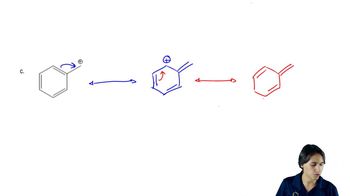
Resonance structures are different ways of drawing the same molecule that illustrate the delocalization of electrons. A molecule with multiple resonance structures can distribute its electron density more evenly, leading to increased stability. The actual structure of the molecule is a hybrid of these resonance forms, which helps in predicting reactivity and stability.
추천 영상:
03:04
Drawing Resonance Structures

Steric Hindrance

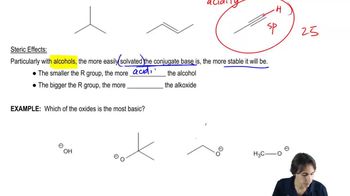
Steric hindrance refers to the repulsion between bulky groups within a molecule that can affect its stability and reactivity. When atoms or groups are too close together, they can create strain, making the molecule less stable. Understanding steric effects is crucial for predicting the behavior of different species in chemical reactions.
추천 영상:
02:53
Understanding steric effects.