뒤로
뒤로 Bruice 8th EditionCh. 8 - Delocalized Electrons: Their Effect on Stability, pKa, and the Products of a Reaction • Aromaticity and Electronic Effects: An Introduction to the Reactions of Benzene
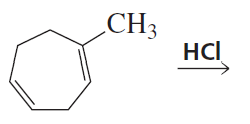
문제 27c
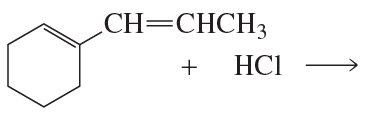
What is the major product of each of the following reactions, assuming that one equivalent of each reagent is used in each reaction?
c.
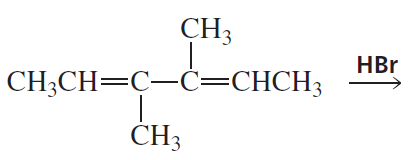
문제 28b
What are the products of the following reactions, assuming that one equivalent of each reagent is used in each reaction?
b.
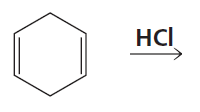
문제 28c
What are the products of the following reactions, assuming that one equivalent of each reagent is used in each reaction?
c.
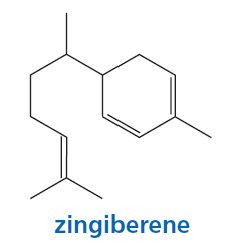
문제 29
Which of the double bonds in zingiberene, the compound responsible for the aroma of ginger, is most reactive in an electrophilic addition reaction with HBr?
문제 31
What products would be obtained from the reaction of 1,3,5-hexatriene with one equivalent of HBr? Disregard stereoisomers.
문제 32a
What are the products of the following reactions, assuming that one equivalent of each reagent is used in each reaction? Disregard stereoisomers.
a.
문제 32b
What are the products of the following reactions, assuming that one equivalent of each reagent is used in each reaction? Disregard stereoisomers.
b.
문제 34
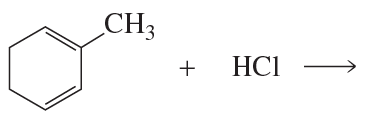
A student wanted to know whether the greater proximity of the nucleophile to the C-2 carbon in the transition state is what causes the 1,2-addition product to be formed faster when 1,3-butadiene reacts with HCl. Therefore, she decided to investigate the reaction of 2-methyl-1,3-cyclohexadiene with HCl. Her friend told her that she should use 1-methyl-1,3-cyclohexadiene instead. Should she follow her friend's advice?
문제 37a
What are the major 1,2- and 1,4-addition products of the following reaction? Indicate the kinetic and the thermodynamic products.
a.
문제 37b
What are the major 1,2- and 1,4-addition products of the following reaction? Indicate the kinetic and the thermodynamic products.
b.
문제 39c
What are the products of the following reactions?
c.
문제 39d
What are the products of the following reactions?
d.
문제 40
What is the major product when the methoxy substituent in the preceding reaction is bonded to C-2 of the diene rather than to C-1?
문제 41
Write a general rule that can be used to predict the major product of a Diels–Alder reaction between an alkene with an electron-withdrawing substituent and a diene with a substituent that can donate electrons by resonance depending on the location of the substituent on the diene.
문제 42b
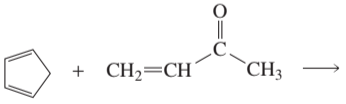
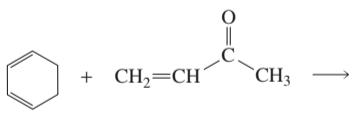
What two products are formed from each of the following reactions?
b.
문제 44a
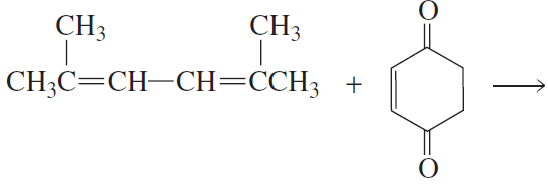
What are the products of the following reactions?
a.
문제 44b
What are the products of the following reactions?
b.
문제 46a
Explain why the following compounds are not optically active:
a. the product obtained from the reaction of 1,3-butadiene with cis-1,2-dichloroethene
문제 46b
Explain why the following compounds are not optically active:
b. the product obtained from the reaction of 1,3-butadiene with trans-1,2-dichloroethene
문제 47e
What diene and what dienophile should be used to synthesize the following?
e.
문제 47f
What diene and what dienophile should be used to synthesize the following?
f.
문제 48a
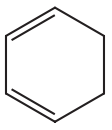
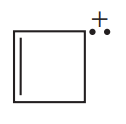
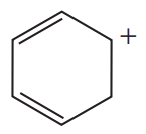
Which of the following are aromatic?
a.
b.
c.
문제 48b
Which of the following are aromatic?
d.
e.
f.
문제 49a
What is the value of n in Hückel's rule when a compound has nine pairs of electrons? b. Is such a compound aromatic?
문제 50a
Which compound in each set is aromatic? Explain your choice.
a.
문제 50b
Which compound in each set is aromatic? Explain your choice.
b.
문제 52a
Predict the relative pKa values of cyclopentadiene and cycloheptatriene.
문제 52b
Predict the relative pKa values of cyclopropene and cyclopropane.
문제 54a
In what direction is the dipole moment in fulvene? Explain.
문제 54b
In what direction is the dipole moment in calicene? Explain.