Ch. 8 - Delocalized Electrons: Their Effect on Stability, pKa, and the Products of a Reaction • Aromaticity and Electronic Effects: An Introduction to the Reactions of Benzene
Bruice - Organic Chemistry 8th Edition
Bruice8th EditionOrganic ChemistryISBN: 9780135213711당신이 사용하는 게 아니라요?교과서 변경
8장, 문제 50a

Which compound in each set is aromatic? Explain your choice.
a. Chemical structures of cyclopene, cyclopropenyl cation, and cyclopropenyl anion with labels beneath each.

검증된 단계별 안내
1
Step 1: Recall the criteria for aromaticity. A compound is aromatic if it satisfies the following conditions: (1) It is cyclic, (2) It is planar, (3) It has a conjugated π-electron system, and (4) It follows Huckel's rule, which states that the molecule must have (4n + 2) π-electrons, where n is a non-negative integer.
Step 2: Analyze cyclopropene. Cyclopropene is cyclic and planar, but it has only two π-electrons in its double bond. Since 2 does not satisfy Huckel's rule (4n + 2 = 2 is not possible for any integer n), cyclopropene is not aromatic.
Step 3: Analyze the cyclopropenyl cation. The cation is cyclic and planar, and it has a conjugated π-electron system. The cation has two π-electrons from the double bond and an additional empty p-orbital on the positively charged carbon. This results in a total of 2 π-electrons, which does not satisfy Huckel's rule. Therefore, the cyclopropenyl cation is not aromatic.
Step 4: Analyze the cyclopropenyl anion. The anion is cyclic and planar, and it has a conjugated π-electron system. The anion has two π-electrons from the double bond and two additional π-electrons from the lone pair on the negatively charged carbon. This results in a total of 4 π-electrons, which satisfies Huckel's rule (4n + 2 = 6, where n = 1). Therefore, the cyclopropenyl anion is aromatic.
Step 5: Conclude that among the given compounds, the cyclopropenyl anion is aromatic because it satisfies all the criteria for aromaticity, including Huckel's rule.

비슷한 문제에 대한 검증된 영상 답변:

이 영상 해법은 위 문제에 도움이 된다고 튜터들이 추천한 것입니다.
영상 길이:
6m
도움이 되었나요?

주요 개념

질문에 올바르게 답하기 위해 반드시 이해해야 하는 핵심 개념들은 다음과 같습니다.

Aromaticity

Aromaticity refers to a property of cyclic compounds that exhibit enhanced stability due to delocalized π electrons. For a compound to be aromatic, it must be cyclic, planar, fully conjugated, and follow Hückel's rule, which states that it should have 4n + 2 π electrons, where n is a non-negative integer.
추천 영상:
08:19
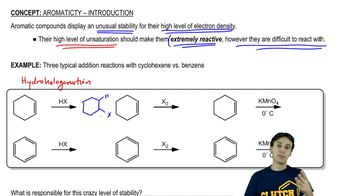
Intro to Aromaticity

Cyclopropene

Cyclopropene is a three-membered cyclic alkene with one double bond. It does not meet the criteria for aromaticity because it has only two π electrons and is not fully conjugated. Its structure leads to significant angle strain, making it less stable than larger cyclic compounds.
추천 영상:
01:49
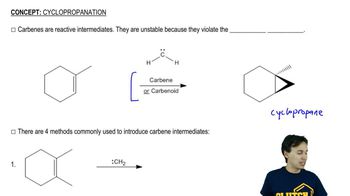
General properties of cyclopropanation.

Cyclopropenyl Cation and Anion

The cyclopropenyl cation and anion are derived from cyclopropene by adding or removing a proton. The cyclopropenyl cation has 2 π electrons and is not aromatic, while the cyclopropenyl anion has 4 π electrons, which also disqualifies it from being aromatic. However, the anion is more stable due to the presence of a negative charge that can be delocalized.
추천 영상:
가이드 코스
1:06
Anionic Polymerization Concept 4