Ch. 8 - Delocalized Electrons: Their Effect on Stability, pKa, and the Products of a Reaction • Aromaticity and Electronic Effects: An Introduction to the Reactions of Benzene
Bruice - Organic Chemistry 8th Edition
Bruice8th EditionOrganic ChemistryISBN: 9780135213711당신이 사용하는 게 아니라요?교과서 변경
8장, 문제 50b

Which compound in each set is aromatic? Explain your choice.
b. Structures of cycloheptatriene, cycloheptatrienyl cation, and cycloheptatrienyl anion with labels.

검증된 단계별 안내
1
Step 1: Recall the criteria for aromaticity. A compound is aromatic if it satisfies the following conditions: (1) It is cyclic, (2) It is planar, (3) It has a conjugated π-electron system, and (4) It follows Hückel's rule, which states that the molecule must have (4n + 2) π-electrons, where n is a non-negative integer.
Step 2: Analyze cycloheptatriene. Cycloheptatriene is cyclic and has conjugated π-electrons, but it does not satisfy Hückel's rule because it has 6 π-electrons, which corresponds to 4n (not 4n + 2). Additionally, the molecule is not fully planar due to the sp3-hybridized carbon atom in the ring.
Step 3: Analyze cycloheptatrienyl cation. The cation is cyclic, planar, and has a conjugated π-electron system. It contains 6 π-electrons, which satisfies Hückel's rule (4n + 2, where n = 1). Therefore, the cycloheptatrienyl cation is aromatic.
Step 4: Analyze cycloheptatrienyl anion. The anion is cyclic and has a conjugated π-electron system, but it contains 8 π-electrons, which does not satisfy Hückel's rule (4n + 2). Thus, the cycloheptatrienyl anion is not aromatic.
Step 5: Conclude that among the three compounds, the cycloheptatrienyl cation is aromatic because it satisfies all the criteria for aromaticity, including Hückel's rule.

비슷한 문제에 대한 검증된 영상 답변:

이 영상 해법은 위 문제에 도움이 된다고 튜터들이 추천한 것입니다.
영상 길이:
3m
도움이 되었나요?

주요 개념

질문에 올바르게 답하기 위해 반드시 이해해야 하는 핵심 개념들은 다음과 같습니다.

Aromaticity

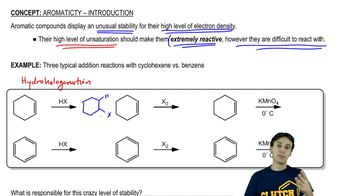
Aromaticity is a property of cyclic compounds that exhibit enhanced stability due to resonance and follow Hückel's rule, which states that a compound must have (4n + 2) π electrons, where n is a non-negative integer. Aromatic compounds are typically planar, fully conjugated, and have a continuous ring of p-orbitals. This unique stability is what distinguishes aromatic compounds from non-aromatic and anti-aromatic compounds.
추천 영상:
08:19
Intro to Aromaticity

Cycloheptatriene

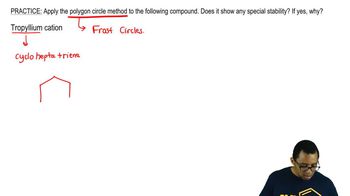
Cycloheptatriene is a seven-membered cyclic hydrocarbon with three double bonds. It is not aromatic because it does not meet the criteria for aromaticity; specifically, it has 6 π electrons, which does not satisfy Hückel's rule. Additionally, cycloheptatriene is not planar and lacks full conjugation, further disqualifying it from being aromatic.
추천 영상:
02:56
Inscribed Polygon Method

Cycloheptatrienyl Cation and Anion

The cycloheptatrienyl cation and anion are charged species derived from cycloheptatriene. The cation has a positive charge and contains 6 π electrons, making it aromatic as it satisfies Hückel's rule. Conversely, the anion has 8 π electrons, which makes it anti-aromatic and thus unstable. Understanding the electronic structure of these ions is crucial for determining their aromaticity.
추천 영상:
가이드 코스
1:06
Anionic Polymerization Concept 4