
Ch. 9 - Substitution and Elimination Reactions of Alkyl Halides
Bruice - Organic Chemistry 8th Edition
Bruice8th EditionOrganic ChemistryISBN: 9780135213711당신이 사용하는 게 아니라요?교과서 변경
9장, 문제 4

Does increasing the energy barrier for an SN2 reaction increase or decrease the magnitude of the rate constant for the reaction?

검증된 단계별 안내
1
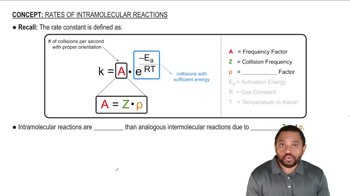
Understand the relationship between the energy barrier and the rate constant: The rate constant (k) for a reaction is related to the activation energy (Ea) through the Arrhenius equation: k=AeEaRT, where A is the pre-exponential factor, R is the gas constant, and T is the temperature.
Recognize that the energy barrier corresponds to the activation energy (Ea): In an SN2 reaction, the energy barrier is the energy required to reach the transition state from the reactants. A higher energy barrier means a larger Ea.
Analyze the effect of increasing Ea on the rate constant: From the Arrhenius equation, as Ea increases, the exponential term eEaRT decreases, which in turn decreases the value of k.
Conclude the relationship: Increasing the energy barrier (Ea) decreases the magnitude of the rate constant (k) for the SN2 reaction because the reaction becomes slower as it requires more energy to overcome the activation energy.
Relate this to reaction conditions: To counteract the effect of a higher energy barrier, one could increase the temperature (T) in the Arrhenius equation, as a higher temperature would increase the rate constant despite a higher Ea.

비슷한 문제에 대한 검증된 영상 답변:

이 영상 해법은 위 문제에 도움이 된다고 튜터들이 추천한 것입니다.
영상 길이:
4m
도움이 되었나요?

주요 개념

질문에 올바르게 답하기 위해 반드시 이해해야 하는 핵심 개념들은 다음과 같습니다.

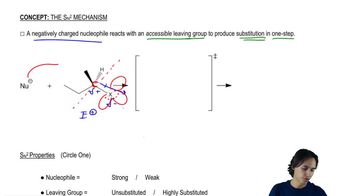
SN2 Reaction Mechanism

The SN2 (substitution nucleophilic bimolecular) reaction is a type of nucleophilic substitution where a nucleophile attacks an electrophile, resulting in the simultaneous displacement of a leaving group. This reaction occurs in a single concerted step, meaning that bond formation and bond breaking happen simultaneously. The rate of an SN2 reaction depends on the concentration of both the nucleophile and the substrate, making it a second-order reaction.
추천 영상:
08:33
Drawing the SN2 Mechanism

Activation Energy and Rate Constant

Activation energy is the minimum energy required for a reaction to occur. According to the Arrhenius equation, the rate constant (k) of a reaction is inversely related to the activation energy; as the energy barrier increases, the rate constant decreases. This relationship highlights how higher activation energy makes it less likely for reactants to successfully collide with enough energy to form products, thus slowing the reaction.
추천 영상:
가이드 코스
2:29
Rates of Intramolecular Reactions Concept 1

Effect of Energy Barrier on Reaction Rate

The energy barrier of a reaction directly influences its rate. In the context of an SN2 reaction, increasing the energy barrier means that fewer molecules will have sufficient energy to overcome this barrier, leading to a decrease in the rate of reaction. Consequently, as the energy barrier rises, the magnitude of the rate constant decreases, indicating a slower reaction rate.
추천 영상:
가이드 코스
2:29
Rates of Intramolecular Reactions Concept 1