Ch. 9 - Substitution and Elimination Reactions of Alkyl Halides
Bruice - Organic Chemistry 8th Edition
Bruice8th EditionOrganic ChemistryISBN: 9780135213711당신이 사용하는 게 아니라요?교과서 변경
9장, 문제 24a,b

Which alkyl halide in each pair is more reactive in an E2 reaction with hydroxide ion?
a.
b.

검증된 단계별 안내
1
Step 1: Understand the E2 reaction mechanism. E2 reactions are bimolecular elimination reactions where a base (such as hydroxide ion) removes a proton from a β-carbon, and a leaving group (such as a halide) departs simultaneously, forming a double bond.
Step 2: Analyze the first pair of alkyl halides. The first structure is a primary alkyl bromide, while the second structure is a secondary alkyl bromide. Secondary alkyl halides are generally more reactive in E2 reactions because the transition state is stabilized by hyperconjugation and inductive effects.
Step 3: Analyze the second pair of alkyl halides. The first structure is cyclohexyl chloride, and the second structure is cyclohexyl bromide. Bromide is a better leaving group than chloride due to its larger size and weaker bond to carbon, making cyclohexyl bromide more reactive in an E2 reaction.
Step 4: Consider steric hindrance and leaving group ability. In the first pair, the secondary alkyl bromide has less steric hindrance at the β-carbon compared to the primary alkyl bromide, facilitating the elimination process. In the second pair, bromide's superior leaving group ability makes it more favorable for elimination.
Step 5: Conclude that for the first pair, the secondary alkyl bromide is more reactive in an E2 reaction. For the second pair, cyclohexyl bromide is more reactive due to the better leaving group ability of bromide compared to chloride.

비슷한 문제에 대한 검증된 영상 답변:

이 영상 해법은 위 문제에 도움이 된다고 튜터들이 추천한 것입니다.
영상 길이:
4m

주요 개념

질문에 올바르게 답하기 위해 반드시 이해해야 하는 핵심 개념들은 다음과 같습니다.

E2 Reaction Mechanism

The E2 (bimolecular elimination) reaction is a type of elimination reaction where a base removes a proton from a β-carbon, leading to the simultaneous departure of a leaving group from the α-carbon. This concerted mechanism results in the formation of a double bond. Understanding the E2 mechanism is crucial for predicting the reactivity of alkyl halides, as the structure and sterics of the substrate significantly influence the reaction rate.
추천 영상:
09:36
Drawing the E2 Mechanism.

Alkyl Halide Structure

Alkyl halides are organic compounds containing a carbon atom bonded to a halogen atom (F, Cl, Br, I). The reactivity of alkyl halides in E2 reactions is influenced by their structure, particularly the degree of substitution (primary, secondary, or tertiary). Tertiary alkyl halides are generally more reactive in E2 reactions due to steric factors that stabilize the transition state, making it easier for the base to abstract a proton.
추천 영상:
01:52
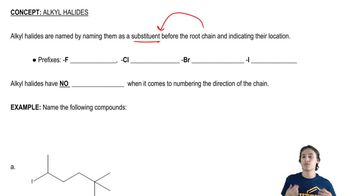
How to name alkyl halides

Base Strength and Sterics

The strength and steric hindrance of the base used in an E2 reaction play a significant role in determining the reaction's outcome. Strong bases, such as hydroxide ion (OH-), are more effective at abstracting protons, while sterically hindered bases may favor elimination over substitution. The choice of base can influence which alkyl halide is more reactive, as bulky bases may favor reactions with less hindered substrates.
추천 영상:
02:53
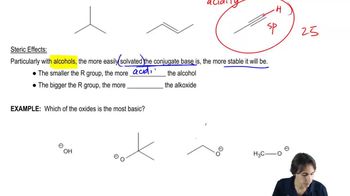
Understanding steric effects.