뒤로
뒤로 Mullins 1st EditionCh. 13 - Alcohols, Ethers and Related Compounds: Substitution and Elimination
문제 17
Rationalize the difference in pKₐ values for the two hydroxyl groups.
문제 18
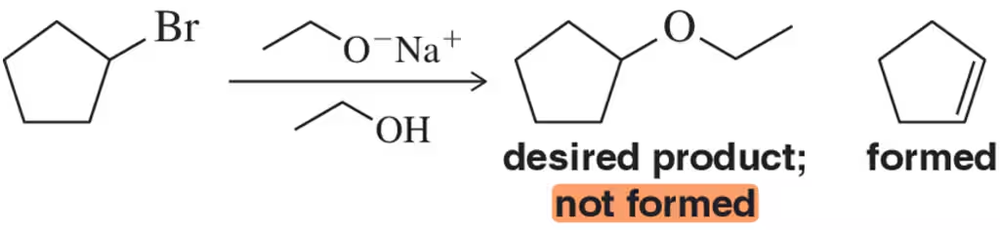
When a secondary haloalkane is treated with sodium ethoxide in ethanol, we predict alkene formation over ether formation. How did we make this determination?
문제 19
In contrast to the results of Assessment 13.18, when a secondary haloalkane is treated with sodium ethanethiolate, we predict formation of a thioether. How is this rationalized?
문제 20
The intended SN2 displacement of the 1° chloride by acetylide is unsuccessful for the molecule below. Why?
문제 21a
Which of the following bases would favorably deprotonate a hydroxyl group?
(a)
문제 21b
Which of the following bases would favorably deprotonate a hydroxyl group?
(b) NaOH
문제 21c
Which of the following bases would favorably deprotonate a hydroxyl group?
(c) NaCN
문제 21d
Which of the following bases would favorably deprotonate a hydroxyl group?
(d) Et3N
문제 21e
Which of the following bases would favorably deprotonate a hydroxyl group?
(e)
문제 22
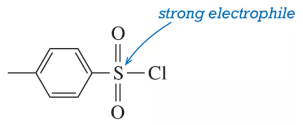
The sulfur atom in toluene sulfonyl chloride (TsCl) is strongly electrophilic. Why?
문제 24a
Predict the product of the following sulfonylation reactions.
(a)
문제 24b
Predict the product of the following sulfonylation reactions.
(b)
문제 24c
Predict the product of the following sulfonylation reactions.
(c)
문제 24d
Predict the product of the following sulfonylation reactions.
(d)
문제 25
Predict the major product(s) of each of the following reactions.
문제 26a
Complete the following multistep syntheses using tosylate formation as one of the steps. The optimum number of steps for each synthesis is shown.
(a)
문제 26b
Complete the following multistep syntheses using tosylate formation as one of the steps. The optimum number of steps for each synthesis is shown.
(b)
문제 26c
Complete the following multistep syntheses using tosylate formation as one of the steps. The optimum number of steps for each synthesis is shown.
(c)
문제 27
On the reaction coordinate diagram for the disfavored nucleophilic displacement of hydroxide, predict the curve that would demonstrate how using a tosylate makes the substitution favorable.
<IMAGE>
문제 28a
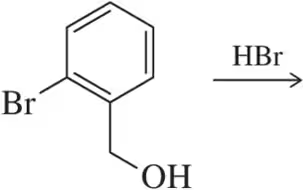
Predict the product of the following reactions.
(a)
문제 28b
Predict the product of the following reactions.
(b)
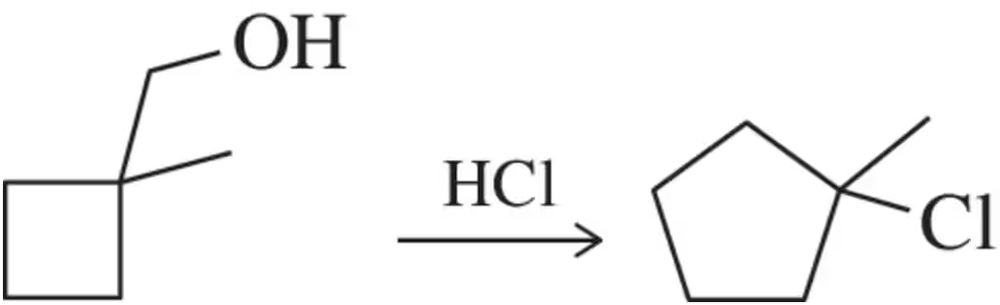
문제 29
Using an excess of HCl in the following reaction resulted in a product that was not simply the substitution of chlorine for the hydroxyl group. Predict the identity of the product obtained.
문제 30
Provide an arrow-pushing mechanism that rationalizes the outcome of the reaction shown.
문제 32
When SOCl2 is used in place of HCl, only one product results. Why are these conditions better?
문제 34a
Identify the reagent that should be used to obtain each stereochemical outcome shown.
(a)
문제 34b
Identify the reagent that should be used to obtain each stereochemical outcome shown.
(b)
문제 35a
Provide the alcohol that would be used to make the bromoalkanes shown using PBr₃.
(a)
문제 35b
Provide the alcohol that would be used to make the bromoalkanes shown using PBr₃.
(b)
문제 35c
Provide the alcohol that would be used to make the bromoalkanes shown using PBr₃.
(c)
문제 36
Besides PBr3. and SOCl2 , there are other ways of synthesizing haloalkanes. One such way is shown. Provide an arrow-pushing mechanism that rationalizes formation of the chloroalkane. [Hint: Dimethyl sulfide is a good nucleophile and Cl₂ is an electrophile. Start by reacting those two together.]