When a secondary haloalkane is treated with sodium ethoxide in ethanol, we predict alkene formation over ether formation. How did we make this determination?
Ch. 13 - Alcohols, Ethers and Related Compounds: Substitution and Elimination

Mullins1st EditionOrganic Chemistry: A Learner Centered ApproachISBN: 9780137566471당신이 사용하는 게 아니라요?교과서 변경
모든 교과서
Mullins 1st Edition
Ch. 13 - Alcohols, Ethers and Related Compounds: Substitution and Elimination
문제 17
Mullins 1st Edition
Ch. 13 - Alcohols, Ethers and Related Compounds: Substitution and Elimination
문제 1712장, 문제 17
Rationalize the difference in pKₐ values for the two hydroxyl groups.

검증된 단계별 안내1
Identify the two hydroxyl groups in the molecule: one is attached directly to the benzene ring (phenol group), and the other is part of an alcohol group attached to the benzyl position.
Recall that the pKₐ value is a measure of the acidity of a compound. A lower pKₐ indicates a stronger acid, meaning the proton is more easily donated.
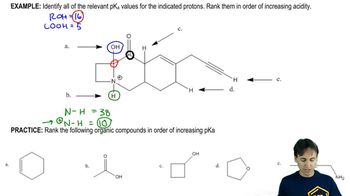
Analyze the phenol group (pKₐ = 10): The hydroxyl group attached to the benzene ring is more acidic due to resonance stabilization. When the proton is lost, the resulting phenoxide ion is stabilized by delocalization of the negative charge across the aromatic ring.
Analyze the alcohol group (pKₐ = 16): The hydroxyl group attached to the benzyl position is less acidic because the conjugate base (alkoxide ion) does not benefit from resonance stabilization. The negative charge remains localized on the oxygen atom, making it less stable.
Compare the two groups: The difference in pKₐ values arises from the resonance stabilization of the phenoxide ion in the phenol group, which makes it easier to lose a proton compared to the alcohol group, where no such stabilization occurs.

비슷한 문제에 대한 검증된 영상 답변:
이 영상 해법은 위 문제에 도움이 된다고 튜터들이 추천한 것입니다.
도움이 되었나요?
주요 개념
질문에 올바르게 답하기 위해 반드시 이해해야 하는 핵심 개념들은 다음과 같습니다.
Acidity and pKa
pKa is a quantitative measure of the strength of an acid in solution, representing the negative logarithm of the acid dissociation constant (Ka). A lower pKa value indicates a stronger acid, meaning it dissociates more readily in solution. Understanding pKa is essential for comparing the acidity of different functional groups, such as hydroxyl groups in this case.
추천 영상:
Identifying pKa values
Hydroxyl Groups
Hydroxyl groups (-OH) are functional groups that can influence the acidity of a compound. The position of the hydroxyl group relative to other substituents in a molecule can affect its ability to donate a proton, thus altering its pKa. Factors such as electronegativity and steric hindrance play significant roles in determining the acidity of hydroxyl groups.
추천 영상:
Sequence Groups
Resonance and Inductive Effects
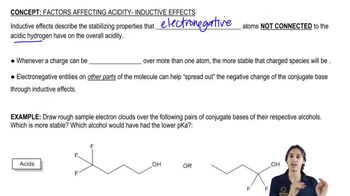
Resonance and inductive effects are key factors that can stabilize or destabilize the conjugate base formed after deprotonation of an acid. Resonance allows for the delocalization of negative charge, which can enhance stability and lower pKa. Inductive effects, caused by electronegative atoms or groups nearby, can either withdraw or donate electron density, further influencing the acidity of hydroxyl groups.
추천 영상:
Understanding the Inductive Effect.
관련 실천
교과서 질문
1991
views
교과서 질문
Suggest a reagent and a reactant that could be combined to make each of the following alcohols.
(d)
710
views
교과서 질문
The intended SN2 displacement of the 1° chloride by acetylide is unsuccessful for the molecule below. Why?
1119
views
교과서 질문
Suggest a reagent and a reactant that could be combined to make each of the following alcohols.
(c)
664
views
교과서 질문
In contrast to the results of Assessment 13.18, when a secondary haloalkane is treated with sodium ethanethiolate, we predict formation of a thioether. How is this rationalized?
1078
views
교과서 질문
Suggest an arrow-pushing mechanism for the following reaction. Is the hydroxyl group acting as a base, acid, Lewis base, or Lewis acid?
1149
views