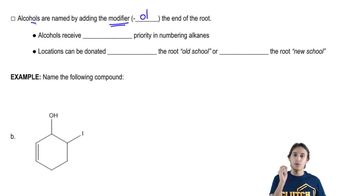
When HCl was used for the attempted dehydration reaction shown, a reaction occurred, but none of the desired product was formed. Suggest the identity of the actual product obtained.
Ch. 13 - Alcohols, Ethers and Related Compounds: Substitution and Elimination

Mullins1st EditionOrganic Chemistry: A Learner Centered ApproachISBN: 9780137566471당신이 사용하는 게 아니라요?교과서 변경
모든 교과서
Mullins 1st Edition
Ch. 13 - Alcohols, Ethers and Related Compounds: Substitution and Elimination
문제 35c
Mullins 1st Edition
Ch. 13 - Alcohols, Ethers and Related Compounds: Substitution and Elimination
문제 35c12장, 문제 35c
Provide the alcohol that would be used to make the bromoalkanes shown using PBr₃.
(c) 
검증된 단계별 안내1
Understand the reaction mechanism: The conversion of alcohols to bromoalkanes using phosphorus tribromide (PBr₃) is a substitution reaction where the hydroxyl group (-OH) of the alcohol is replaced by a bromine atom.
Identify the structure of the bromoalkane: Analyze the given bromoalkane structure to determine the carbon chain and the position of the bromine atom.
Determine the corresponding alcohol: To find the alcohol that would be used, replace the bromine atom in the bromoalkane with a hydroxyl group (-OH) at the same position.
Consider stereochemistry: If the bromoalkane has chiral centers, ensure that the stereochemistry is considered, as the reaction with PBr₃ can lead to inversion of configuration at the chiral center.
Verify the alcohol structure: Double-check the structure of the alcohol to ensure it matches the requirements for the reaction with PBr₃, considering factors like primary, secondary, or tertiary alcohols.

비슷한 문제에 대한 검증된 영상 답변:
이 영상 해법은 위 문제에 도움이 된다고 튜터들이 추천한 것입니다.
영상 길이:
2m도움이 되었나요?
주요 개념
질문에 올바르게 답하기 위해 반드시 이해해야 하는 핵심 개념들은 다음과 같습니다.
Alcohols
Alcohols are organic compounds characterized by the presence of a hydroxyl group (-OH) attached to a carbon atom. They serve as key starting materials in various chemical reactions, including the formation of bromoalkanes. Understanding the structure and reactivity of alcohols is essential for predicting the outcome of reactions involving PBr₃.
추천 영상:
How to name alcohols
Bromoalkanes
Bromoalkanes, also known as alkyl bromides, are organic compounds where a bromine atom is bonded to an alkyl group. They are typically synthesized from alcohols through substitution reactions using reagents like PBr₃. Recognizing the structure of bromoalkanes helps in identifying the corresponding alcohol precursor needed for their synthesis.
PBr₃ Reaction Mechanism
Phosphorus tribromide (PBr₃) is a reagent used to convert alcohols into bromoalkanes via a substitution reaction. The mechanism involves the formation of an intermediate where the hydroxyl group is replaced by a bromine atom. Understanding this mechanism is crucial for determining which alcohol will yield the desired bromoalkane product.
추천 영상:
Heck Reaction Mechanism
관련 실천
교과서 질문
1193
views
교과서 질문
Provide the alcohol that would be used to make the bromoalkanes shown using PBr₃.
(a)
976
views
교과서 질문
Provide the alcohol that would be used to make the bromoalkanes shown using PBr₃.
(b)
894
views
교과서 질문
Besides PBr3. and SOCl2 , there are other ways of synthesizing haloalkanes. One such way is shown. Provide an arrow-pushing mechanism that rationalizes formation of the chloroalkane. [Hint: Dimethyl sulfide is a good nucleophile and Cl₂ is an electrophile. Start by reacting those two together.]
408
views
교과서 질문
Identify the reagent that should be used to obtain each stereochemical outcome shown.
(b)
852
views
교과서 질문
Predict which side of the equilibrium is favored by ∆H, ∆G, and ∆S.
1160
views