Ch. 14 - Structural Identification 1: Infrared Spectroscopy and Mass Spectrometry
Mullins - Organic Chemistry: A Learner Centered Approach 1st Edition
Mullins1st EditionOrganic Chemistry: A Learner Centered ApproachISBN: 9780137566471당신이 사용하는 게 아니라요?교과서 변경
13장, 문제 2a(i)

Given the molecular formula, (i) what functional groups are possible in each of the following molecules?
(a) C6H14O

검증된 단계별 안내
1
Step 1: Calculate the degree of unsaturation (also known as the index of hydrogen deficiency, IHD) to determine the presence of double bonds, triple bonds, or rings. Use the formula: IHD = (2C + 2 - H + N - X)/2, where C = number of carbons, H = number of hydrogens, N = number of nitrogens, and X = number of halogens. For C₆H₁₄O, substitute C = 6, H = 14, and O = 1. Note that oxygen does not affect the IHD calculation.
Step 2: Analyze the IHD result. If IHD = 0, the molecule is fully saturated, meaning there are no double bonds, triple bonds, or rings. If IHD > 0, the molecule may contain unsaturation (e.g., double bonds, triple bonds, or rings).
Step 3: Consider the functional groups that can include oxygen in a saturated molecule (if IHD = 0). These functional groups could include alcohols (R-OH) or ethers (R-O-R').
Step 4: If IHD > 0, consider additional functional groups that could include oxygen and unsaturation. These could include carbonyl-containing groups such as aldehydes (R-CHO), ketones (R-CO-R'), carboxylic acids (R-COOH), or esters (R-COOR').
Step 5: Use the molecular formula and the possible functional groups to propose structures. For example, if IHD = 0, the molecule could be a straight-chain or branched alcohol or ether. If IHD > 0, propose structures with double bonds, rings, or carbonyl groups consistent with the molecular formula.

비슷한 문제에 대한 검증된 영상 답변:

이 영상 해법은 위 문제에 도움이 된다고 튜터들이 추천한 것입니다.
영상 길이:
4m
도움이 되었나요?

주요 개념

질문에 올바르게 답하기 위해 반드시 이해해야 하는 핵심 개념들은 다음과 같습니다.

Functional Groups

Functional groups are specific groups of atoms within molecules that are responsible for the characteristic chemical reactions of those molecules. Common functional groups include hydroxyl (-OH), carbonyl (C=O), carboxyl (-COOH), and amine (-NH₂). Identifying functional groups is crucial for predicting the reactivity and properties of organic compounds.
추천 영상:
가이드 코스
02:36
Identifying Functional Groups

Molecular Formula

A molecular formula provides the number and type of atoms in a molecule, represented by symbols and subscripts. For example, C₆H₁₄O indicates a molecule with six carbon atoms, fourteen hydrogen atoms, and one oxygen atom. Understanding the molecular formula helps in deducing possible structures and functional groups present in the compound.
추천 영상:
가이드 코스
02:17
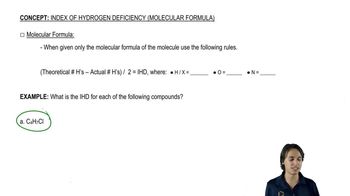
How to use IHD with molecular formula.

Isomerism

Isomerism refers to the existence of compounds with the same molecular formula but different structural arrangements or spatial orientations. For C₆H₁₄O, isomers can exhibit different functional groups or arrangements, leading to variations in chemical properties and reactivity. Recognizing isomerism is essential for understanding the diversity of organic compounds.
추천 영상:
가이드 코스
06:47
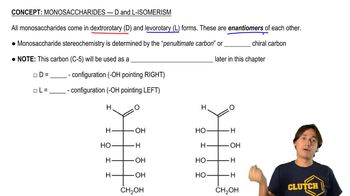
Monosaccharides - D and L Isomerism