뒤로
뒤로 Mullins 1st EditionCh. 14 - Structural Identification 1: Infrared Spectroscopy and Mass Spectrometry
문제 43a
Identify the peaks in the mass spectrum of octan-4-one that correspond to (a) α-cleavage.
<IMAGE>
문제 43b
Identify the peaks in the mass spectrum of octan-4-one that correspond to (b) the McLafferty rearrangement.
<IMAGE>
문제 44
2-Methylnonan-4-one can undergo two different McLafferty rearrangements. Draw the products of each of them.
문제 45
Assign the structure based on the mass spectrum and IR spectrum shown.
<IMAGE>
문제 46e
Based on Hooke's law, choose the bond in each pair that you expect to vibrate at a higher wavenumber.
(e) C=N vs C≡N
문제 46f
Based on Hooke's law, choose the bond in each pair that you expect to vibrate at a higher wavenumber.
(f) C―S vs C=O
문제 47b
Choose the bond in each pair that you expect to have the more intense stretching band
(b) C=O vs. C=N
문제 48a
Identify the important bands you would expect to find in an IR spectrum for the following molecules.
(a)
문제 48c
Identify the important bands you would expect to find in an IR spectrum for the following molecules.
(c)
문제 49b
What functional groups might be present in the IR spectra for the molecules with the given molecular formulas. [Be sure to use the molecular formula in your analysis.]
(b) C₃H₄O₄
<IMAGE>
문제 51
A carboxylic acid can be converted to an ester using the conditions shown. Explain how a comparison of an IR spectrum of the reactant(s) and product can be used to determine whether the reaction was successful or not.
문제 52
Hoping to make the following diene, a chemist treated the diol shown with acid. Based on the IR spectrum, was the reaction successful? If not, what compound was made instead?
<IMAGE>
문제 54
Under acidic conditions, alkene A can be isomerized to the more stable alkene B. How could IR spectroscopy be used to distinguish between A and B? [There are a few correct answers.]
문제 55
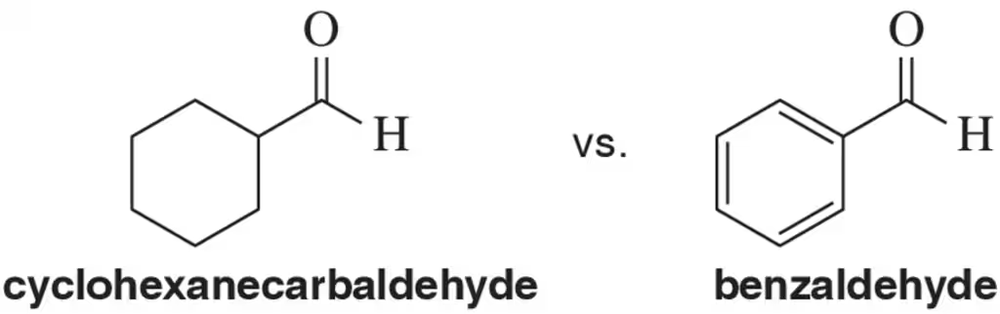
Would you expect the stretching band of the carbonyl to appear at a higher frequency for cyclohexanecarbaldehyde or benzaldehyde? Explain.
문제 56
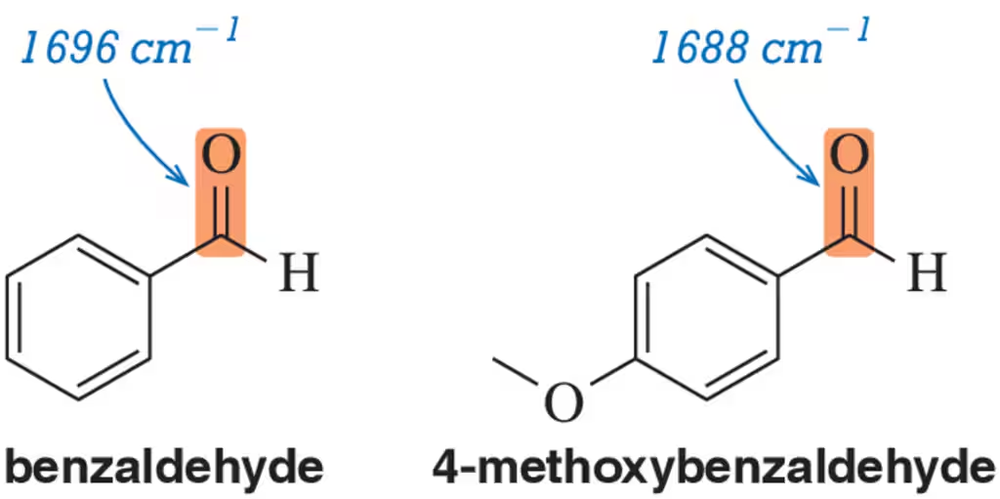
Justify the carbonyl stretching frequencies indicated for benzaldehyde and 4-methoxybenzaldehyde.
문제 57
Justify the carbonyl stretching frequencies for a series of methoxybenzaldehydes. Specifically, why are the 2- and 4-methoxy derivatives similar to each other but different from the 3-methoxy derivative?
문제 58
Justify the carbonyl stretching frequencies indicated for 3-chlorobenzaldehyde and 3-fluorobenzaldehyde.
문제 59
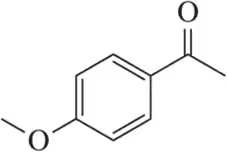
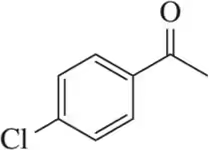
Rank the following acetophenone derivatives on the basis of the carbonyl stretching frequency (1 = highest ; 4 = lowest ).
(a)
(b)
(c)
(d)
문제 60a
The first step of a reaction called electrophilic aromatic substitution is as follows:
If this step is rate-determining for the overall reaction, which benzene derivative would you expect to react most quickly? Which would react most slowly?
(a)
문제 62b
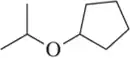
For each of the molecules shown, predict the structure of at least one major fragment in the mass spectrum.
(b)
문제 62d
For each of the molecules shown, predict the structure of at least one major fragment in the mass spectrum.
(d)
문제 62e
For each of the molecules shown, predict the structure of at least one major fragment in the mass spectrum.
(e)
문제 64
Give the structure of the molecule that gives rise to the following IR and mass spectra.
<IMAGE>
문제 68
What ratio of M, M + 2 , M + 4 and would you expect for 1,6-dibromohexane?