Ch. 14 - Structural Identification 1: Infrared Spectroscopy and Mass Spectrometry
Mullins - Organic Chemistry: A Learner Centered Approach 1st Edition
Mullins1st EditionOrganic Chemistry: A Learner Centered ApproachISBN: 9780137566471당신이 사용하는 게 아니라요?교과서 변경
13장, 문제 5

Rank the boiling points of the following molecules. Explain your ranking ( 1 = highest bp; 3 = lowest bp ).
Three molecular structures are shown, each with varying functional groups, for boiling point comparison.

검증된 단계별 안내
1
Step 1: Identify the molecular structures of the given molecules. Look for functional groups, molecular weight, and the presence of polar bonds or hydrogen bonding capabilities.
Step 2: Analyze the intermolecular forces present in each molecule. Molecules with stronger intermolecular forces (e.g., hydrogen bonding, dipole-dipole interactions, or London dispersion forces) typically have higher boiling points.
Step 3: Consider the molecular size and surface area. Larger molecules or those with extended surface areas tend to have stronger London dispersion forces, which can increase boiling points.
Step 4: Evaluate the polarity of each molecule. Polar molecules generally have higher boiling points than nonpolar molecules due to dipole-dipole interactions.
Step 5: Rank the molecules based on the strength of their intermolecular forces, molecular size, and polarity. Assign 1 to the molecule with the highest boiling point and 3 to the molecule with the lowest boiling point.

비슷한 문제에 대한 검증된 영상 답변:

이 영상 해법은 위 문제에 도움이 된다고 튜터들이 추천한 것입니다.
영상 길이:
3m

주요 개념

질문에 올바르게 답하기 위해 반드시 이해해야 하는 핵심 개념들은 다음과 같습니다.

Intermolecular Forces

Intermolecular forces are the attractive forces between molecules that influence physical properties like boiling points. The main types include hydrogen bonding, dipole-dipole interactions, and London dispersion forces. Molecules with stronger intermolecular forces generally have higher boiling points because more energy is required to separate them during the phase change from liquid to gas.
추천 영상:
03:01
How Van der Waals forces work.

Molecular Weight

Molecular weight, or molar mass, refers to the mass of a molecule and can affect boiling points. Generally, larger molecules with greater molecular weights exhibit higher boiling points due to increased London dispersion forces, which arise from temporary dipoles in larger electron clouds. However, this effect can be overshadowed by the presence of stronger intermolecular forces like hydrogen bonding.
추천 영상:
08:41
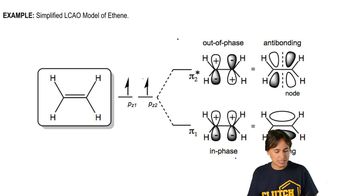
Review of Molecular Orbitals

Polarity

Polarity describes the distribution of electrical charge over the atoms in a molecule. Polar molecules have a significant difference in electronegativity between bonded atoms, leading to dipole-dipole interactions that can elevate boiling points. In contrast, nonpolar molecules primarily experience weaker London dispersion forces, resulting in lower boiling points. Understanding the polarity of the molecules in question is crucial for accurately ranking their boiling points.
추천 영상:
2:04
Molecular Polarity