Ch. 16 - Metals in Organic Chemistry
Mullins - Organic Chemistry: A Learner Centered Approach 1st Edition
Mullins1st EditionOrganic Chemistry: A Learner Centered ApproachISBN: 9780137566471당신이 사용하는 게 아니라요?교과서 변경
15장, 문제 19

Work backward to show how the cyclopropane would be synthesized from the chloroalkane shown.
Chloroalkane structure with a question mark leading to a cyclopropane, indicating a three-step retrosynthesis process.

검증된 단계별 안내
1
Step 1: Identify the target molecule (cyclopropane derivative) and the starting material (benzyl chloride). The goal is to synthesize the cyclopropane ring from the chloroalkane through a series of reactions.
Step 2: Recognize that the formation of a cyclopropane ring typically involves a carbene or carbenoid intermediate. To generate this intermediate, the chloroalkane can undergo deprotonation to form a carbanion, followed by reaction with a reagent like CH2I2 (diiodomethane) in the presence of Zn/Cu to form the cyclopropane ring.
Step 3: Consider the stereochemistry of the target molecule. The (+/-) notation indicates the formation of a racemic mixture, meaning both enantiomers of the cyclopropane are formed. This suggests that the reaction mechanism does not favor one stereoisomer over the other.
Step 4: Plan the reaction sequence. First, treat the benzyl chloride with a strong base (e.g., NaOH or KOH) to form the benzyl carbanion. Next, react the carbanion with diiodomethane (CH2I2) in the presence of Zn/Cu to generate the cyclopropane ring.
Step 5: Verify the reaction conditions and intermediates. Ensure that the reagents used (base, CH2I2, Zn/Cu) are appropriate for the formation of the cyclopropane ring and that the stereochemistry aligns with the racemic mixture observed in the product.

비슷한 문제에 대한 검증된 영상 답변:

이 영상 해법은 위 문제에 도움이 된다고 튜터들이 추천한 것입니다.
영상 길이:
10m

주요 개념

질문에 올바르게 답하기 위해 반드시 이해해야 하는 핵심 개념들은 다음과 같습니다.

Cyclopropane Synthesis

Cyclopropane can be synthesized through various methods, including the reaction of alkenes with reagents that facilitate cyclization. One common approach is the use of a chloroalkane, which can undergo nucleophilic substitution or elimination reactions to form the cyclopropane structure. Understanding the mechanisms of these reactions is crucial for determining the synthetic pathway.
추천 영상:
가이드 코스
1:16
Synthesis of Amino Acids: Strecker Synthesis Example 1

Nucleophilic Substitution

Nucleophilic substitution is a fundamental reaction in organic chemistry where a nucleophile attacks an electrophilic carbon atom, replacing a leaving group. In the context of synthesizing cyclopropane from a chloroalkane, this process can involve the formation of a cyclic intermediate, which is essential for constructing the three-membered ring characteristic of cyclopropane.
추천 영상:
01:47
Nucleophiles and Electrophiles can react in Substitution Reactions.

Elimination Reactions

Elimination reactions involve the removal of atoms or groups from a molecule, resulting in the formation of a double bond or a ring structure. In synthesizing cyclopropane, elimination can occur from a chloroalkane to generate an alkene, which can then undergo further reactions to form the cyclopropane. Understanding the conditions and mechanisms of elimination is vital for successful synthesis.
추천 영상:
00:40
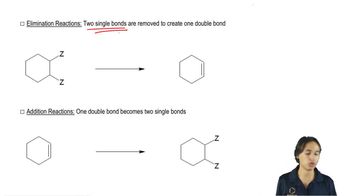
Recognizing Elimination Reactions.