
Ch. 16 - Metals in Organic Chemistry
Mullins - Organic Chemistry: A Learner Centered Approach 1st Edition
Mullins1st EditionOrganic Chemistry: A Learner Centered ApproachISBN: 9780137566471당신이 사용하는 게 아니라요?교과서 변경
15장, 문제 10

Working backward, design a synthesis of the following alcohol using two different epoxide/Grignard reagent combinations.
Chemical structure of an alcohol featuring a three-membered ring and a hydroxyl group (OH) attached to a carbon chain.

검증된 단계별 안내
1
Step 1: Analyze the target alcohol structure. The molecule contains a secondary alcohol group (-OH) attached to a carbon that is connected to a cyclopropyl group and a chain ending in a tert-butyl group. This suggests that the alcohol was formed via nucleophilic attack on an epoxide followed by protonation.
Step 2: Identify possible epoxide precursors. The secondary alcohol could be formed by opening an epoxide at the position where the -OH group is located. Two potential epoxides are: (1) an epoxide with the cyclopropyl group and tert-butyl group already attached, or (2) an epoxide with the cyclopropyl group attached and a simpler alkyl chain that can be extended using a Grignard reagent.
Step 3: Select Grignard reagents for each pathway. For the first pathway, the Grignard reagent could be tert-butyl magnesium bromide (to introduce the tert-butyl group). For the second pathway, the Grignard reagent could be cyclopropyl magnesium bromide (to introduce the cyclopropyl group).
Step 4: Propose the synthesis for pathway 1. Use an epoxide with the cyclopropyl group and tert-butyl group already attached. React this epoxide with a Grignard reagent (e.g., tert-butyl magnesium bromide) to open the epoxide and form the secondary alcohol after protonation.
Step 5: Propose the synthesis for pathway 2. Use an epoxide with the cyclopropyl group attached and a simpler alkyl chain. React this epoxide with a Grignard reagent (e.g., cyclopropyl magnesium bromide) to open the epoxide and form the secondary alcohol after protonation. Extend the alkyl chain to include the tert-butyl group in subsequent steps.

비슷한 문제에 대한 검증된 영상 답변:

이 영상 해법은 위 문제에 도움이 된다고 튜터들이 추천한 것입니다.
영상 길이:
5m

주요 개념

질문에 올바르게 답하기 위해 반드시 이해해야 하는 핵심 개념들은 다음과 같습니다.

Epoxide Chemistry

Epoxides are three-membered cyclic ethers that are highly reactive due to the strain in their ring structure. They can undergo nucleophilic ring-opening reactions, which are essential in organic synthesis. When reacted with Grignard reagents, epoxides can be transformed into alcohols, with the regioselectivity of the reaction depending on the substitution pattern of the epoxide.
추천 영상:
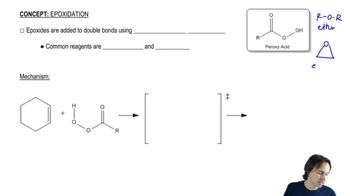
02:19
General properties of epoxidation.

Grignard Reagents

Grignard reagents are organomagnesium compounds that act as strong nucleophiles in organic reactions. They can react with electrophiles, including carbonyl compounds and epoxides, to form new carbon-carbon bonds. Understanding the reactivity and selectivity of Grignard reagents is crucial for designing synthetic pathways to alcohols from epoxides.
추천 영상:
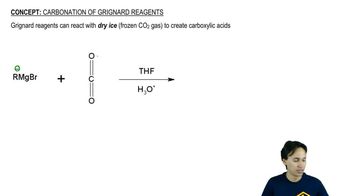
02:12
Carbonation of Grignard Reagents

Synthesis Design

Synthesis design involves planning a series of chemical reactions to construct a target molecule from simpler starting materials. This process requires knowledge of reaction mechanisms, functional group transformations, and the ability to predict the outcomes of various reagent combinations. In this case, designing two different pathways to synthesize the same alcohol using epoxides and Grignard reagents illustrates the versatility of synthetic strategies in organic chemistry.
추천 영상:
가이드 코스
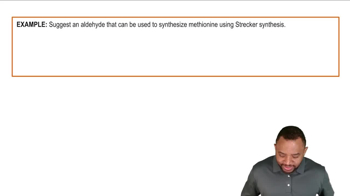
1:16
Synthesis of Amino Acids: Strecker Synthesis Example 1