뒤로
뒤로
문제 61g(v)
Predict the product(s) that would result when the alkenes shown here are allowed to react under the following conditions: (v) 1. Hg(OAc)2 , H2O 2. NaBH4
(g)
문제 61g(iv)
Predict the product(s) that would result when the alkenes shown here are allowed to react under the following conditions: (iv) H2SO4 , H2O
(g)
문제 61k(i)
Predict the product(s) that would result when the alkenes shown here are allowed to react under the following conditions: (i) HBr
(k)
문제 61k(v)
Predict the product(s) that would result when the alkenes shown here are allowed to react under the following conditions: (v) 1. Hg(OAc)2 , H2O 2. NaBH4
(k)
문제 61k(iv)
Predict the product(s) that would result when the alkenes shown here are allowed to react under the following conditions: (iv) H2SO4 , H2O
(k)
문제 61k(ii)
Predict the product(s) that would result when the alkenes shown here are allowed to react under the following conditions:(ii) HCl
(k)
문제 61k(vi)
Predict the product(s) that would result when the alkenes shown here are allowed to react under the following conditions: (vi) 1. BH3 2. H2O2, NaOH
(k)
문제 61k(iii)
Predict the product(s) that would result when the alkenes shown here are allowed to react under the following conditions: (iii) HBr, H2O2
(k)
문제 62b
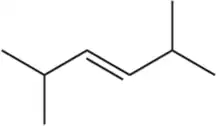
Which of the following alkenes would you expect to react fastest with HBr in each pair?
(b)
문제 64
Which of the following cycloalkanes would you expect to produce the least heat upon combustion when measured per CH2? Explain your answer.
문제 65
Cyclooctene is one of the smaller rings that can form a trans alkene. Would you expect cis-cyclooctene or trans-cyclooctene to react more quickly in an acid-catalyzed hydration reaction?
문제 66b
How many stereoisomers are possible for the following alkenes?
(b)
문제 66c
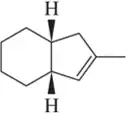
How many stereoisomers are possible for the following alkenes?
(c)
문제 66d
How many stereoisomers are possible for the following alkenes?
(d)
문제 67
Because of the angle strain present in cyclopropanes, they tend to open up in the presence of nearby radicals. Show a mechanism for the following reaction that demonstrates this principle.
문제 68a
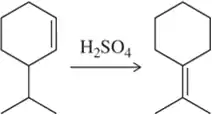
When using sulfuric acid, but in the absence of other nucleophiles like water or bromide ion, less stable alkenes can be isomerized to their more stable isomer. Provide a mechanism for these acid-catalyzed isomerization reactions. [This is one illustration of the principle of microscopic reversibility.]
(a)
문제 68b
When using sulfuric acid, but in the absence of other nucleophiles like water or bromide ion, less stable alkenes can be isomerized to their more stable isomer. Provide a mechanism for these acid-catalyzed isomerization reactions. [This is one illustration of the principle of microscopic reversibility.]
(b)
문제 68c
When using sulfuric acid, but in the absence of other nucleophiles like water or bromide ion, less stable alkenes can be isomerized to their more stable isomer. Provide a mechanism for these acid-catalyzed isomerization reactions. [This is one illustration of the principle of microscopic reversibility.]
(c)
문제 70
If you react carvone with a single equivalent of HBr, only one product is produced, even though carvone has two carbon–carbon double bonds. Explain this observation.
문제 71b
Predict the product of each of the following hydroboration–oxidation or oxymercuration–reduction reactions used in the modern synthetic organic chemistry literature (modified to use reagents we are used to seeing).
(b) A two-step hydroboration–oxidation was used to prepare a silanediol peptidomimetic as a serine protease inhibitor (Org. Lett. 2012, 14, 4422–4425).
문제 71c
Predict the product of each of the following hydroboration–oxidation or oxymercuration–reduction reactions used in the modern synthetic organic chemistry literature (modified to use reagents we are used to seeing).
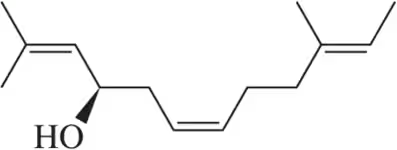
(c) A similar sequence was featured in the synthesis of muricadienin, a proposed precursor in the biosynthesis of solamin (Org. Lett. 2014, 16, 5886–5889).
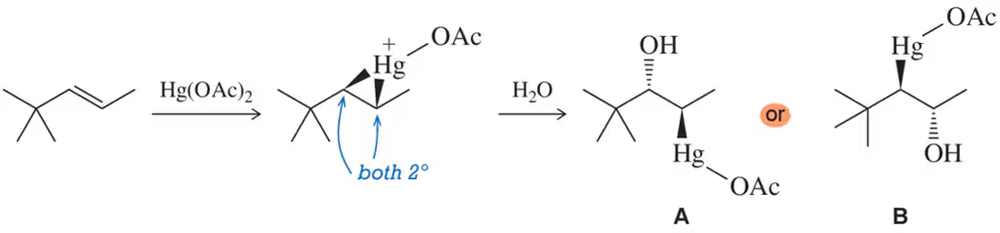
문제 73
A common situation occurs when both carbons of the mercurinium ion are secondary. In a situation like the one shown, to which carbon would you expect water to add? That is, would you expect to produce A or B? Explain your answer.
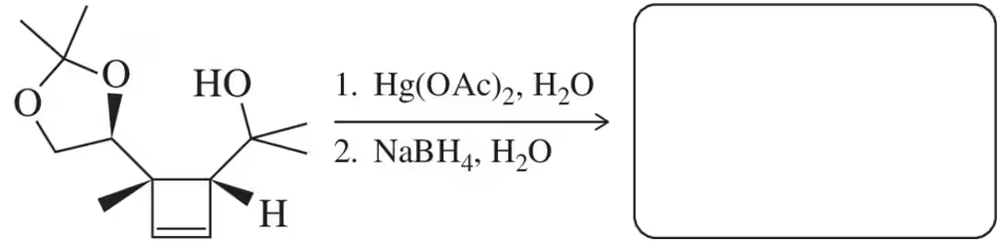
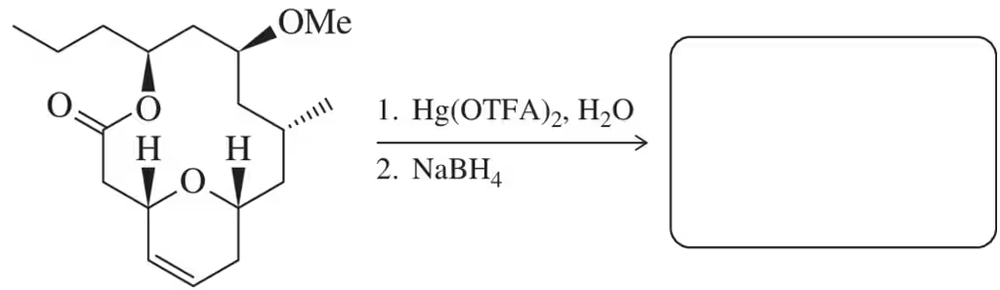
문제 74b
In light of your answer to Assessment 8.73, predict the product of the following oxymercuration–reduction reactions, each of which results in a single product. [Don't worry about the absolute stereochemistry, though these reactions are also stereoselective.]
(b) This reaction sequence was used in the synthesis of (+) -lineatin, a monoterpene aggregation pheromone from the female ambrosia beetle Trypodendron lineatum (Org. Lett. 2004, 6, 1449–1452).
문제 74c
In light of your answer to Assessment 8.73, predict the product of the following oxymercuration–reduction reactions, each of which results in a single product. [Don't worry about the absolute stereochemistry, though these reactions are also stereoselective.]
(c) Oxymercuration–reduction was used in the stereoselective synthesis of the macrolactone core of neopeltolide, a marine macrolide isolated from a Caribbean sponge that has potent anticancer activity (Org. Lett. 2012, 14, 2346–2349).
문제 75
The formation of five-membered ring ethers is an important goal in synthetic organic chemistry because tetrahydrofurans are contained within a number of antitumor natural products. Toward that end, a one-pot synthesis of a bis-THF containing compound was developed (Eur. J. Org. Chem. 2010, 6263–6268). Suggest a mechanism for this transformation.
문제 76a
North American termite soldiers, when encountering enemy insects, contract their mandibular muscles, expelling a mixture of chemicals that essentially trap their enemies in a glue-like substance. This weapon, built into the face of the termite, is called the fontanellar gun. It releases a mixture of pinene (62%), myrcene (27%), and limonene (11%). pinene myrcene limonene 62% 27% 11%
(a) Identify the isoprene units in pinene, myrcene, and limonene.
문제 76b
North American termite soldiers, when encountering enemy insects, contract their mandibular muscles, expelling a mixture of chemicals that essentially trap their enemies in a glue-like substance. This weapon, built into the face of the termite, is called the fontanellar gun. It releases a mixture of pinene (62%), myrcene (27%), and limonene (11%).
(b) Suggest an acid-catalyzed mechanism by which pinene could be produced from limonene.
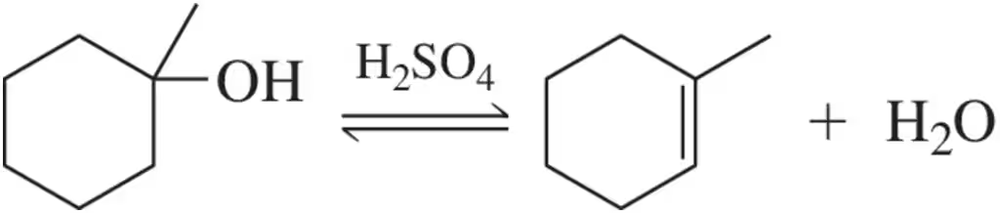
문제 77a
The acid-catalyzed hydration we learned here in Chapter 8 is reversible.
(a) Propose a mechanism for the formation of an alkene from an alcohol.
문제 77c
The acid-catalyzed hydration we learned here in Chapter 8 is reversible:
(c) Which side of the reaction would be favored by running the reaction at high temperatures?
문제 77d
The acid-catalyzed hydration we learned here in Chapter 8 is reversible:
(d) How might you shift the equilibrium to the right?