Ch. 8 - Alkenes 1: Properties and Electrophilic Additions
Mullins - Organic Chemistry: A Learner Centered Approach 1st Edition
Mullins1st EditionOrganic Chemistry: A Learner Centered ApproachISBN: 9780137566471당신이 사용하는 게 아니라요?교과서 변경
7장, 문제 77d

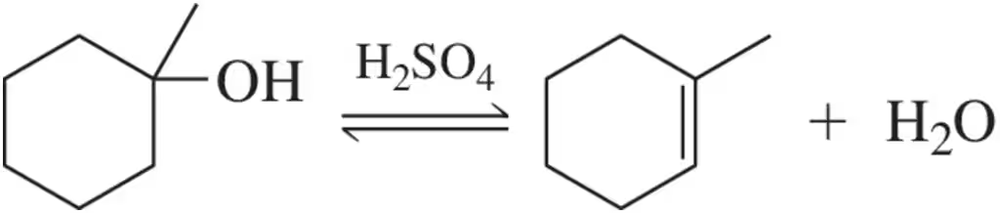
The acid-catalyzed hydration we learned here in Chapter 8 is reversible:
Chemical reaction diagram showing the dehydration of an alcohol to form an alkene, with sulfuric acid as a catalyst.
(d) How might you shift the equilibrium to the right?

검증된 단계별 안내
1
Step 1: Understand the acid-catalyzed hydration reaction. This reaction involves the addition of water (H₂O) to an alkene in the presence of an acid catalyst, forming an alcohol. The reaction is reversible, meaning the alcohol can revert back to the alkene and water under certain conditions.
Step 2: Recall Le Chatelier's Principle. This principle states that if a dynamic equilibrium is disturbed by changing the conditions, the system will adjust to counteract the disturbance and restore equilibrium. To shift the equilibrium to the right (toward the alcohol formation), you need to favor the forward reaction.
Step 3: Increase the concentration of water. By adding excess water to the reaction mixture, you increase the reactant concentration, which drives the equilibrium toward the formation of the alcohol (the product).
Step 4: Remove the alcohol product as it forms. If the alcohol is continuously removed from the reaction mixture (e.g., by distillation or extraction), the equilibrium will shift to the right to produce more alcohol to replace what was removed.
Step 5: Optimize reaction conditions. Ensure the acid catalyst is present in sufficient quantity and maintain appropriate temperature and pressure conditions that favor the forward reaction. Avoid conditions that favor the reverse reaction, such as high temperatures that might promote dehydration of the alcohol back to the alkene.

비슷한 문제에 대한 검증된 영상 답변:

이 영상 해법은 위 문제에 도움이 된다고 튜터들이 추천한 것입니다.
영상 길이:
2m

주요 개념

질문에 올바르게 답하기 위해 반드시 이해해야 하는 핵심 개념들은 다음과 같습니다.

Le Chatelier's Principle

Le Chatelier's Principle states that if a dynamic equilibrium is disturbed by changing the conditions, the position of equilibrium shifts to counteract the change. In the context of acid-catalyzed hydration, this principle can be applied to predict how changes in concentration, temperature, or pressure can influence the direction of the reaction.
추천 영상:
04:12
The Electron Configuration

Acid-Catalyzed Hydration

Acid-catalyzed hydration is a reaction where an alkene reacts with water in the presence of an acid to form an alcohol. This process involves the formation of a carbocation intermediate and is reversible, meaning that the products can revert to reactants under certain conditions. Understanding this mechanism is crucial for manipulating the reaction's equilibrium.
추천 영상:
06:34
Acid-catalyzed hydration mechanism

Equilibrium Constant (K)

The equilibrium constant (K) quantifies the ratio of the concentrations of products to reactants at equilibrium for a reversible reaction. A larger K value indicates a greater concentration of products at equilibrium, while a smaller K suggests that reactants are favored. By manipulating conditions such as concentration or temperature, one can influence the value of K and shift the equilibrium position.
추천 영상:
02:19
The relationship between equilibrium constant and pKa.