Ch. 8 - Alkenes 1: Properties and Electrophilic Additions
Mullins - Organic Chemistry: A Learner Centered Approach 1st Edition
Mullins1st EditionOrganic Chemistry: A Learner Centered ApproachISBN: 9780137566471당신이 사용하는 게 아니라요?교과서 변경
7장, 문제 77c

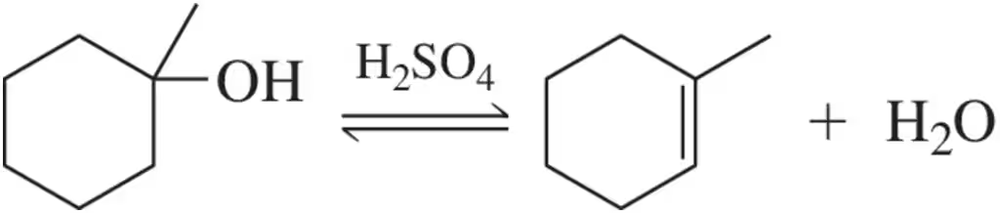
The acid-catalyzed hydration we learned here in Chapter 8 is reversible:
Chemical reaction diagram showing the dehydration of an alcohol to form an alkene, with sulfuric acid as a catalyst.
(c) Which side of the reaction would be favored by running the reaction at high temperatures?

검증된 단계별 안내
1
Step 1: Recognize that the reaction shown is an equilibrium between an alcohol and an alkene, with water as a byproduct. The reaction is acid-catalyzed using H2SO4.
Step 2: Recall Le Chatelier's Principle, which states that a system at equilibrium will shift to counteract changes in conditions. Temperature is one such condition that can influence the equilibrium.
Step 3: Understand that this reaction involves a dehydration process (removal of water) to form the alkene. Dehydration reactions are typically endothermic, meaning they absorb heat.
Step 4: Since the reaction is endothermic, increasing the temperature will favor the formation of products (alkene and water) because higher temperatures drive endothermic reactions forward.
Step 5: Conclude that running the reaction at high temperatures will favor the side of the reaction that produces the alkene and water, shifting the equilibrium toward the products.

비슷한 문제에 대한 검증된 영상 답변:

이 영상 해법은 위 문제에 도움이 된다고 튜터들이 추천한 것입니다.
영상 길이:
4m
도움이 되었나요?

주요 개념

질문에 올바르게 답하기 위해 반드시 이해해야 하는 핵심 개념들은 다음과 같습니다.

Le Chatelier's Principle

Le Chatelier's Principle states that if a dynamic equilibrium is disturbed by changing the conditions, the position of equilibrium shifts to counteract the change. In the context of acid-catalyzed hydration, increasing temperature will favor the endothermic direction of the reaction, which can help predict the favored side of the reaction under high-temperature conditions.
추천 영상:
04:12
The Electron Configuration

Endothermic vs. Exothermic Reactions

Reactions can be classified as endothermic or exothermic based on their heat exchange with the surroundings. Endothermic reactions absorb heat, while exothermic reactions release heat. Understanding which side of the hydration reaction is endothermic or exothermic is crucial for predicting how temperature changes will affect the equilibrium position.
추천 영상:
03:06
1,2 vs. 1,4 products

Equilibrium Constant (K)

The equilibrium constant (K) quantifies the ratio of the concentrations of products to reactants at equilibrium for a reversible reaction. Changes in temperature can alter the value of K, influencing the position of equilibrium. A higher temperature may shift the equilibrium towards the side with a higher K value, indicating a preference for products or reactants depending on the reaction's thermodynamics.
추천 영상:
02:19
The relationship between equilibrium constant and pKa.
관련 실천
교과서 질문

The acid-catalyzed hydration we learned here in Chapter 8 is reversible:

(d) How might you shift the equilibrium to the right?

1402
views

교과서 질문

The reaction of (E)-3-chlorohex-3-ene with HCl results in the selective formation of 3,3-dichlorohexane instead of 3,4-dichlorohexane. Explain this result.

1572
views
교과서 질문

The acid-catalyzed hydration we learned here in Chapter 8 is reversible.

(a) Propose a mechanism for the formation of an alkene from an alcohol.

1304
views
교과서 질문

North American termite soldiers, when encountering enemy insects, contract their mandibular muscles, expelling a mixture of chemicals that essentially trap their enemies in a glue-like substance. This weapon, built into the face of the termite, is called the fontanellar gun. It releases a mixture of pinene (62%), myrcene (27%), and limonene (11%). pinene myrcene limonene 62% 27% 11%

(a) Identify the isoprene units in pinene, myrcene, and limonene.

1068
views
교과서 질문

North American termite soldiers, when encountering enemy insects, contract their mandibular muscles, expelling a mixture of chemicals that essentially trap their enemies in a glue-like substance. This weapon, built into the face of the termite, is called the fontanellar gun. It releases a mixture of pinene (62%), myrcene (27%), and limonene (11%).

(b) Suggest an acid-catalyzed mechanism by which pinene could be produced from limonene.

793
views
교과서 질문

The acid-catalyzed hydration we learned here in Chapter 8 is reversible:

(e) How might you shift the equilibrium to the left?

1206
views