Ch. 8 - Alkenes 1: Properties and Electrophilic Additions
Mullins - Organic Chemistry: A Learner Centered Approach 1st Edition
Mullins1st EditionOrganic Chemistry: A Learner Centered ApproachISBN: 9780137566471당신이 사용하는 게 아니라요?교과서 변경
7장, 문제 61g(v)

Predict the product(s) that would result when the alkenes shown here are allowed to react under the following conditions: (v) 1. Hg(OAc)2 , H2O 2. NaBH4
(g) Structural representation of alkenes for hydrohalogenation reaction with HBr.

검증된 단계별 안내
1
Identify the reaction type: The given reagents, Hg(OAc)₂, H₂O followed by NaBH₄, indicate an oxymercuration-demercuration reaction. This reaction is used to hydrate alkenes (add H and OH) without carbocation rearrangement.
Analyze the alkene structure: Determine the position of the double bond in the given alkene. The double bond will dictate where the addition of H and OH occurs.
Understand regioselectivity: Oxymercuration-demercuration follows Markovnikov's rule, meaning the OH group will add to the more substituted carbon of the double bond, while the H will add to the less substituted carbon.
Write the intermediate: In the first step, Hg(OAc)₂ reacts with the alkene to form a mercurinium ion intermediate. This intermediate is then attacked by water (H₂O), leading to the addition of an OH group to the more substituted carbon.
Complete the reaction: In the second step, NaBH₄ reduces the intermediate, replacing the mercury group with a hydrogen atom. This results in the final product, where the alkene has been converted into an alcohol with Markovnikov regioselectivity.

비슷한 문제에 대한 검증된 영상 답변:

이 영상 해법은 위 문제에 도움이 된다고 튜터들이 추천한 것입니다.
영상 길이:
4m

주요 개념

질문에 올바르게 답하기 위해 반드시 이해해야 하는 핵심 개념들은 다음과 같습니다.

Markovnikov's Rule

Markovnikov's Rule states that in the addition of HX to an alkene, the hydrogen atom will attach to the carbon with the greater number of hydrogen atoms already attached. This principle helps predict the regioselectivity of reactions involving alkenes, guiding the formation of more stable carbocation intermediates during electrophilic addition.
추천 영상:
03:54
The 18 and 16 Electron Rule

Oxymercuration-Demercuration

Oxymercuration-Demercuration is a two-step reaction used to convert alkenes into alcohols. The first step involves the addition of mercuric acetate (Hg(OAc)₂) and water to the alkene, forming a mercurial intermediate. The second step, using sodium borohydride (NaBH₄), reduces the mercurial compound to yield the corresponding alcohol, following Markovnikov's addition.
추천 영상:
05:
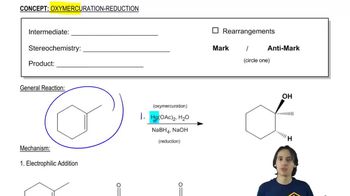
General properties of oxymercuration-reduction.

Reduction Reactions

Reduction reactions involve the gain of electrons or hydrogen, or the loss of oxygen. In the context of the oxymercuration-demercuration process, NaBH₄ acts as a reducing agent, converting the mercuric intermediate into a stable alcohol. Understanding reduction is crucial for predicting the final product of the reaction sequence.
추천 영상:
07:12
Reductive Amination