
Ch.1 - Structure and Bonding
Wade - Organic Chemistry 9th Edition
Wade9th EditionOrganic ChemistryISBN: 9780135213728당신이 사용하는 게 아니라요?교과서 변경
1장, 문제 47b

Compound X, isolated from lanolin (sheep's wool fat), has the pungent aroma of dirty sweatsocks. A careful analysis showed that compound X contains 62.0% carbon and 10.4% hydrogen. No nitrogen or halogen was found.
b. A molecular weight determination showed that compound X has a molecular weight of approximately 117. Find the molecular formula of compound X.

검증된 단계별 안내
1
Step 1: Begin by determining the empirical formula of compound X. Assume a 100 g sample of the compound, which means it contains 62.0 g of carbon and 10.4 g of hydrogen. The remaining mass will be oxygen, as no nitrogen or halogen is present.
Step 2: Convert the masses of carbon and hydrogen to moles. Use the molar mass of carbon (12.01 g/mol) and hydrogen (1.008 g/mol) to find the number of moles of each element.
Step 3: Calculate the moles of oxygen by subtracting the mass of carbon and hydrogen from the total mass (100 g) to find the mass of oxygen, then convert this mass to moles using the molar mass of oxygen (16.00 g/mol).
Step 4: Determine the simplest whole number ratio of moles of carbon, hydrogen, and oxygen to find the empirical formula. Divide the moles of each element by the smallest number of moles calculated in the previous steps.
Step 5: Use the empirical formula to calculate its molar mass. Compare this with the given molecular weight of compound X (117 g/mol) to find the molecular formula. Multiply the subscripts in the empirical formula by a whole number to match the molecular weight.

비슷한 문제에 대한 검증된 영상 답변:

이 영상 해법은 위 문제에 도움이 된다고 튜터들이 추천한 것입니다.
영상 길이:
8m

주요 개념

질문에 올바르게 답하기 위해 반드시 이해해야 하는 핵심 개념들은 다음과 같습니다.

Empirical Formula Calculation

The empirical formula represents the simplest whole-number ratio of elements in a compound. To find it, convert the percentage composition of each element to moles by dividing by their atomic masses. Then, divide each by the smallest number of moles to get the simplest ratio. This step is crucial for determining the molecular formula.
추천 영상:
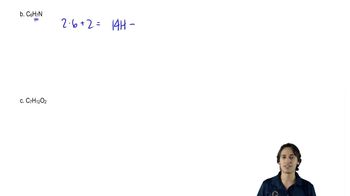
00:46
Calculating IHD using molecular formula

Molecular Formula Determination

The molecular formula is a multiple of the empirical formula and represents the actual number of atoms of each element in a molecule. To find it, calculate the empirical formula mass and divide the given molecular weight by this mass. The result is the factor by which the subscripts in the empirical formula must be multiplied to obtain the molecular formula.
추천 영상:
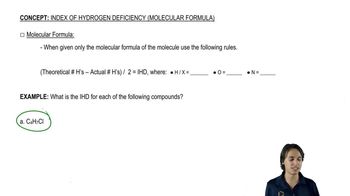
02:17
How to use IHD with molecular formula.

Elemental Analysis

Elemental analysis involves determining the percentage composition of each element in a compound. This data is essential for calculating the empirical formula. In this problem, the analysis shows the presence of carbon and hydrogen, which guides the calculation of the empirical formula and subsequently the molecular formula, given the absence of nitrogen and halogens.
추천 영상:
06:56
Understanding the Element Effect.
관련 실천
교과서 질문

In 1934, Edward A. Doisy of Washington University extracted 3000 lb of hog ovaries to isolate a few milligrams of pure estradiol, a potent female hormone. Doisy burned 5.00 mg of this precious sample in oxygen and found that 14.54 mg of CO2 and 3.97 mg of H2O were generated.

b. The molecular weight of estradiol was later determined to be 272. Determine the molecular formula of estradiol.

1494
views
1
rank
교과서 질문

Compound X, isolated from lanolin (sheep’s wool fat), has the pungent aroma of dirty sweatsocks. A careful analysis showed that compound X contains 62.0% carbon and 10.4% hydrogen. No nitrogen or halogen was found.

a. Compute an empirical formula for compound X

788
views
교과서 질문

Use resonance structures to identify the areas of high and low electron density in the following compounds:

g.

h.

669
views
교과서 질문

In 1934, Edward A. Doisy of Washington University extracted 3000 lb of hog ovaries to isolate a few milligrams of pure estradiol, a potent female hormone. Doisy burned 5.00 mg of this precious sample in oxygen and found that 14.54 mg of CO2 and 3.97 mg of H2O were generated.

a. Determine the empirical formula of estradiol.

801
views
교과서 질문

Use resonance structures to identify the areas of high and low electron density in the following compounds:

i.

j.

482
views
교과서 질문

If the carbon atom in CH2Cl2 were flat, there would be two stereoisomers. The carbon atom in CH2Cl2 is actually tetrahedral. Make a model of this compound, and determine whether there are any stereoisomers of CH2Cl2

1084
views