
Ch.1 - Structure and Bonding
Wade - Organic Chemistry 9th Edition
Wade9th EditionOrganic ChemistryISBN: 9780135213728당신이 사용하는 게 아니라요?교과서 변경
1장, 문제 46i,j

Use resonance structures to identify the areas of high and low electron density in the following compounds:
i. Chemical structure showing resonance forms with nitrogen and oxygen atoms, highlighting electron density distribution.
j. Chemical structure of a methoxybenzaldehyde compound, showing resonance structures and electron density areas.

검증된 단계별 안내
1
Begin by identifying the pi bonds and lone pairs in the given compounds. These are the primary contributors to resonance structures.
Draw the initial Lewis structure for each compound, ensuring all atoms have complete octets where applicable.
Identify possible resonance structures by moving electrons from pi bonds or lone pairs to adjacent atoms, forming new pi bonds or lone pairs. Ensure that the overall charge of the molecule remains unchanged.
For each resonance structure, determine the areas of high electron density (typically where lone pairs or negative charges are located) and low electron density (typically where positive charges or electron-deficient atoms are located).
Compare the resonance structures to identify the most stable structure, which often has the least charge separation and places negative charges on more electronegative atoms. This will help pinpoint the areas of high and low electron density in the compound.

비슷한 문제에 대한 검증된 영상 답변:

이 영상 해법은 위 문제에 도움이 된다고 튜터들이 추천한 것입니다.
영상 길이:
4m
도움이 되었나요?

주요 개념

질문에 올바르게 답하기 위해 반드시 이해해야 하는 핵심 개념들은 다음과 같습니다.

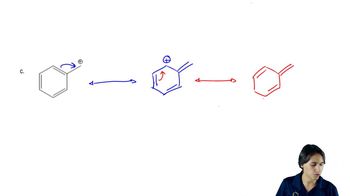
Resonance Structures

Resonance structures are different Lewis structures for the same molecule that depict the same arrangement of atoms but differ in the distribution of electrons. These structures help illustrate the delocalization of electrons within a molecule, which can affect its stability and reactivity. Understanding resonance is crucial for predicting the behavior of compounds, especially in terms of electron density distribution.
추천 영상:
03:04
Drawing Resonance Structures

Electron Density

Electron density refers to the probability of finding electrons in a given region of a molecule. Areas of high electron density are typically associated with negative charges or lone pairs, while low electron density areas may correspond to positive charges or electron-deficient sites. Analyzing electron density is essential for understanding molecular interactions, reactivity, and the stability of resonance structures.
추천 영상:
03:54
The 18 and 16 Electron Rule

Delocalization

Delocalization is the phenomenon where electrons are spread out over several atoms rather than being localized between two atoms. This occurs in systems with resonance, where multiple structures contribute to the overall electron distribution. Delocalization can enhance the stability of a molecule and influence its chemical properties, making it a key concept in understanding resonance and electron density.
추천 영상:
01:47
Understanding the Inductive Effect.