Ch. 2 - Acids and Bases; Functional Groups
Wade - Organic Chemistry 9th Edition
Wade9th EditionOrganic ChemistryISBN: 9780135213728당신이 사용하는 게 아니라요?교과서 변경
2장, 문제 42a

Hydrogen peroxide (HOOH) has a pKa of 11.6, making it roughly 10,000 times as strong an acid as water (pKa = 15.7). Explain why H2O2 is a stronger acid than H2O.

검증된 단계별 안내
1
Understand the concept of pKa: The pKa value is a measure of the strength of an acid. A lower pKa value indicates a stronger acid because it implies the acid more readily donates protons (H⁺ ions) in solution.
Compare the pKa values: Hydrogen peroxide (HOOH) has a pKa of 11.6, while water (H₂O) has a pKa of 15.7. Since 11.6 is lower than 15.7, HOOH is a stronger acid than H₂O.
Analyze the molecular structure: The O-O bond in hydrogen peroxide is weaker and more polar than the O-H bond in water. This makes it easier for HOOH to donate a proton, contributing to its stronger acidic nature.
Consider the stability of the conjugate base: When HOOH donates a proton, it forms the conjugate base HO₂⁻. The presence of an additional oxygen atom in HO₂⁻ compared to OH⁻ (the conjugate base of water) can stabilize the negative charge through resonance and inductive effects, making the conjugate base more stable.
Relate acidity to conjugate base stability: The greater stability of the conjugate base (HO₂⁻) compared to OH⁻ is a key reason why HOOH is a stronger acid than H₂O. A more stable conjugate base corresponds to a stronger acid.

비슷한 문제에 대한 검증된 영상 답변:

이 영상 해법은 위 문제에 도움이 된다고 튜터들이 추천한 것입니다.
영상 길이:
3m

주요 개념

질문에 올바르게 답하기 위해 반드시 이해해야 하는 핵심 개념들은 다음과 같습니다.

Acid Strength and pKa

The strength of an acid is determined by its ability to donate protons (H+ ions) in solution. The pKa value is a logarithmic measure of this ability; lower pKa values indicate stronger acids. Hydrogen peroxide (H2O2) has a pKa of 11.6, which is lower than water's pKa of 15.7, indicating that H2O2 is a stronger acid than H2O.
추천 영상:
07:45
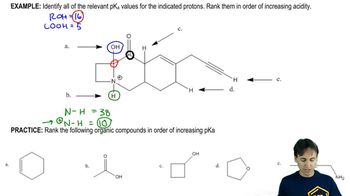
Identifying pKa values

Molecular Structure and Stability

The molecular structure of a compound affects its acidity. In hydrogen peroxide, the presence of the O-O bond and the additional oxygen atom can stabilize the negative charge on the conjugate base (HO2-) after losing a proton, more effectively than in water (OH-). This increased stability of the conjugate base contributes to H2O2's stronger acidity.
추천 영상:
03:43
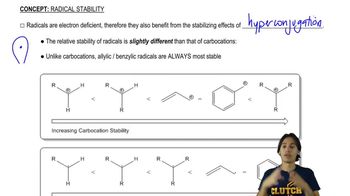
The radical stability trend.

Resonance and Inductive Effects

Resonance and inductive effects can influence acid strength. In H2O2, the electronegative oxygen atoms can delocalize the negative charge through resonance, stabilizing the conjugate base. Additionally, the inductive effect from the extra oxygen atom in H2O2 can pull electron density away, making it easier for the molecule to release a proton, thus enhancing its acidity compared to water.
추천 영상:
01:47
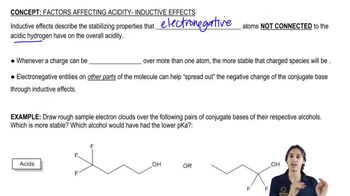
Understanding the Inductive Effect.