
Ch. 2 - Acids and Bases; Functional Groups
Wade - Organic Chemistry 9th Edition
Wade9th EditionOrganic ChemistryISBN: 9780135213728당신이 사용하는 게 아니라요?교과서 변경
2장, 문제 40a

The following compound can become protonated on any of the three nitrogen atoms. One of these nitrogens is much more basic than the others, however.

a. Draw the important resonance forms of the products of protonation on each of the three nitrogen atoms.

검증된 단계별 안내
1
Identify the three nitrogen atoms in the compound: N1 (leftmost), N2 (rightmost), and N3 (top). Each nitrogen can potentially be protonated.
Consider protonation at N1: Add a proton (H⁺) to N1, forming a positive charge on N1. Draw resonance structures by moving the lone pair electrons from N1 to form a double bond with the adjacent carbon, and adjust the electrons on the other atoms accordingly.
Consider protonation at N2: Add a proton (H⁺) to N2, forming a positive charge on N2. Draw resonance structures by moving the lone pair electrons from N2 to form a double bond with the adjacent carbon, and adjust the electrons on the other atoms accordingly.
Consider protonation at N3: Add a proton (H⁺) to N3, forming a positive charge on N3. Draw resonance structures by moving the lone pair electrons from N3 to form a double bond with the adjacent carbon, and adjust the electrons on the other atoms accordingly.
Evaluate the stability of the resonance structures: The nitrogen with the most stable resonance forms upon protonation is the most basic. Consider factors such as the ability to delocalize the positive charge and the electronegativity of the atoms involved.

비슷한 문제에 대한 검증된 영상 답변:

이 영상 해법은 위 문제에 도움이 된다고 튜터들이 추천한 것입니다.
영상 길이:
8m

주요 개념

질문에 올바르게 답하기 위해 반드시 이해해야 하는 핵심 개념들은 다음과 같습니다.

Basicity of Nitrogen Atoms

Basicity refers to the ability of a compound to accept protons (H+). In the context of nitrogen atoms, their basicity is influenced by factors such as hybridization, steric hindrance, and the presence of electron-donating or withdrawing groups. In the given compound, the nitrogen atom that is more basic can accept a proton more readily due to its electronic environment.
추천 영상:
가이드 코스
1:45
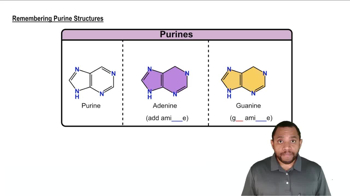
Nitrogenous Bases Concept 3

Protonation and Resonance

Protonation is the addition of a proton to a molecule, which can significantly alter its structure and reactivity. In the case of nitrogen atoms, protonation can lead to the formation of positively charged ammonium ions. The resonance forms of these products illustrate how the positive charge can be delocalized across different nitrogen atoms, affecting the stability and reactivity of the resulting species.
추천 영상:
03:04
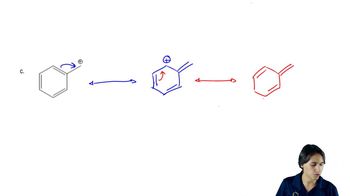
Drawing Resonance Structures

Resonance Structures

Resonance structures are different ways of drawing a molecule that represent the same compound, showing the delocalization of electrons. For the compound in question, drawing resonance forms after protonation on each nitrogen atom helps visualize how the positive charge can be distributed among the nitrogens, which is crucial for understanding the stability and reactivity of the protonated species.
추천 영상:
03:04
Drawing Resonance Structures