Ch. 2 - Acids and Bases; Functional Groups
Wade - Organic Chemistry 9th Edition
Wade9th EditionOrganic ChemistryISBN: 9780135213728당신이 사용하는 게 아니라요?교과서 변경
2장, 문제 20a

Acetic acid can also react as a very weak base (pKb = 20). Two different sites on acetic acid might become protonated to give the conjugate acid. Draw both of these possible conjugate acids, and explain (resonance) why the correct one is more stable. Calculate the pKa of this conjugate acid.

검증된 단계별 안내
1
Identify the structure of acetic acid, which is \( \text{CH}_3\text{COOH} \). It contains a carboxyl group \( \text{COOH} \) and a methyl group \( \text{CH}_3 \).
Consider the two possible sites for protonation: the carbonyl oxygen in the carboxyl group and the hydroxyl oxygen. Protonation at the carbonyl oxygen would result in the conjugate acid \( \text{CH}_3\text{C(OH)OH}^+ \), while protonation at the hydroxyl oxygen would result in \( \text{CH}_3\text{COOH}_2^+ \).
Analyze the resonance structures for each conjugate acid. For \( \text{CH}_3\text{C(OH)OH}^+ \), resonance can stabilize the positive charge by delocalizing it over the oxygen atoms. In contrast, \( \text{CH}_3\text{COOH}_2^+ \) has limited resonance stabilization as the positive charge is localized on the hydroxyl oxygen.
Explain why \( \text{CH}_3\text{C(OH)OH}^+ \) is more stable due to resonance. The ability to delocalize the positive charge over the oxygen atoms in the carboxyl group increases stability, making this the correct conjugate acid.
To calculate the \( pK_a \) of the conjugate acid \( \text{CH}_3\text{C(OH)OH}^+ \), use the relationship \( pK_a + pK_b = 14 \). Given \( pK_b = 20 \), solve for \( pK_a \) using \( pK_a = 14 - pK_b \).

비슷한 문제에 대한 검증된 영상 답변:

이 영상 해법은 위 문제에 도움이 된다고 튜터들이 추천한 것입니다.
영상 길이:
3m
도움이 되었나요?

주요 개념

질문에 올바르게 답하기 위해 반드시 이해해야 하는 핵심 개념들은 다음과 같습니다.

Acid-Base Chemistry

Acid-base chemistry involves the transfer of protons between molecules. Acetic acid can act as a weak base, accepting a proton to form a conjugate acid. Understanding the acid-base behavior of acetic acid is crucial for predicting its reactivity and stability in different chemical environments.
추천 영상:
가이드 코스
02:49
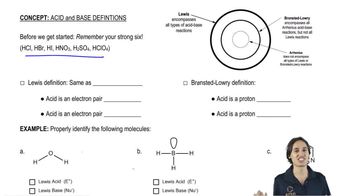
The Lewis definition of acids and bases.

Resonance Stabilization

Resonance stabilization refers to the delocalization of electrons across adjacent atoms, which can enhance the stability of a molecule. In acetic acid, resonance can occur when the protonation site allows for electron delocalization, making one conjugate acid more stable than the other. This concept is key to determining the preferred protonation site.
추천 영상:
가이드 코스
03:43
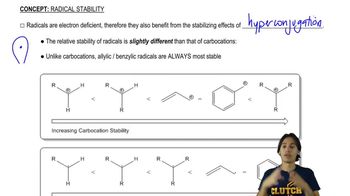
The radical stability trend.

pKa and pKb Values

pKa and pKb are measures of acidity and basicity, respectively, indicating the strength of an acid or base. The pKa of a conjugate acid can be calculated using the pKb of the base and the relationship between pKa, pKb, and the ionization constant of water. Understanding these values helps predict the behavior of acetic acid in acid-base reactions.
추천 영상:
가이드 코스
07:45
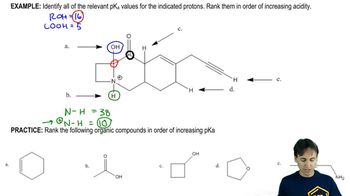
Identifying pKa values