Ch.10 - Structure and Synthesis of Alcohols
Wade - Organic Chemistry 9th Edition
Wade9th EditionOrganic ChemistryISBN: 9780135213728당신이 사용하는 게 아니라요?교과서 변경
10장, 문제 47

Compound A (C7H11Br) is treated with magnesium in ether to give B (C7H11MgBr), which reacts violently with D2O to give 1-methylcyclohexene with a deuterium atom on the methyl group (C). Reaction of B with acetone (CH3COCH3) followed by hydrolysis gives D (C10H18O). Heating D with concentrated H2SO4 gives E (C10H16), which decolorizes two equivalents of Br2 to give F (C10H16Br4). E undergoes hydrogenation with excess H2 and a Pt catalyst to give isobutylcyclohexane. Determine the structures of compounds A through F, and show your reasoning throughout.

검증된 단계별 안내
1
Step 1: Analyze the structure of compound A (C7H11Br). The presence of bromine suggests it is an alkyl halide. The molecular formula indicates one degree of unsaturation (double bond, ring, or triple bond). Based on the reaction with magnesium in ether, A is likely a bromocycloalkene or bromocycloalkane.
Step 2: Understand the reaction of A with magnesium in ether to form B (C7H11MgBr). This is a Grignard reagent formation, where the bromine atom in A reacts with magnesium to form the organomagnesium compound. The Grignard reagent is highly reactive and will attack electrophiles like D2O or acetone.
Step 3: Examine the reaction of B with D2O to form C. The violent reaction indicates that the Grignard reagent reacts with D2O to replace the MgBr group with a deuterium atom. The product, 1-methylcyclohexene with a deuterium atom on the methyl group, suggests that the original structure of A includes a cyclohexene ring with a methyl group attached.
Step 4: Analyze the reaction of B with acetone (CH3COCH3) followed by hydrolysis to form D (C10H18O). The Grignard reagent reacts with the carbonyl group of acetone to form a tertiary alcohol after hydrolysis. The molecular formula of D confirms the addition of the acetone molecule to the Grignard reagent.
Step 5: Investigate the subsequent reactions of D. Heating D with concentrated H2SO4 leads to dehydration, forming E (C10H16), an alkene. The decolorization of two equivalents of Br2 by E indicates the presence of two double bonds in E. Hydrogenation of E with excess H2 and a Pt catalyst forms isobutylcyclohexane, confirming that E is a diene with a cyclohexane ring and an isobutyl group.

비슷한 문제에 대한 검증된 영상 답변:

이 영상 해법은 위 문제에 도움이 된다고 튜터들이 추천한 것입니다.
영상 길이:
16m
도움이 되었나요?

주요 개념

질문에 올바르게 답하기 위해 반드시 이해해야 하는 핵심 개념들은 다음과 같습니다.

Grignard Reagents

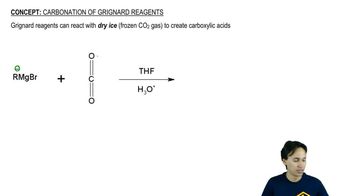
Grignard reagents are organomagnesium compounds formed by the reaction of an alkyl or aryl halide with magnesium in an anhydrous ether. They are highly reactive and serve as nucleophiles in organic synthesis, allowing for the formation of carbon-carbon bonds. In this question, the formation of compound B from compound A illustrates the utility of Grignard reagents in building complex organic structures.
추천 영상:
02:12
Carbonation of Grignard Reagents

Electrophilic Addition Reactions

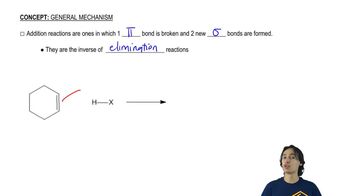
Electrophilic addition reactions involve the addition of an electrophile to a nucleophile, typically across a double bond. In the context of this question, the reaction of compound B with acetone demonstrates how a Grignard reagent can add to a carbonyl group, leading to the formation of a new carbon-carbon bond. Understanding this concept is crucial for predicting the products of the reactions described.
추천 영상:
05:39
Features of Addition Mechanisms.

Hydrogenation and Dehydrohalogenation

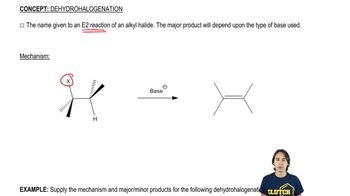
Hydrogenation is the process of adding hydrogen to unsaturated compounds, often using a catalyst, to convert alkenes or alkynes into alkanes. Conversely, dehydrohalogenation involves the elimination of hydrogen halides from alkyl halides to form alkenes. In this question, the hydrogenation of compound E to form isobutylcyclohexane and the decolorization of Br2 are key steps that illustrate these fundamental reactions in organic chemistry.
추천 영상:
03:02
The dehydrohalogenation mechanism.