
Ch.10 - Structure and Synthesis of Alcohols
Wade - Organic Chemistry 9th Edition
Wade9th EditionOrganic ChemistryISBN: 9780135213728당신이 사용하는 게 아니라요?교과서 변경
10장, 문제 46b

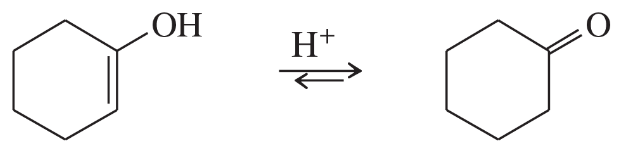
Vinyl alcohols are generally unstable, quickly isomerizing to carbonyl compounds. Propose mechanisms for the following isomerizations.
(b)

검증된 단계별 안내
1
Step 1: Recognize that the reaction involves the isomerization of a vinyl alcohol to a carbonyl compound (ketone). This process is typically acid-catalyzed and follows the principle of keto-enol tautomerism.
Step 2: Protonation of the hydroxyl group (-OH) occurs first under acidic conditions. The lone pair of electrons on the oxygen atom of the hydroxyl group interacts with the H⁺ ion, forming a positively charged oxonium ion.
Step 3: The double bond in the vinyl alcohol shifts to form a carbocation intermediate. This happens as the π-electrons from the double bond move to stabilize the positive charge on the oxygen atom.
Step 4: Deprotonation occurs next. A base (such as water or another molecule in the solution) removes a proton from the α-carbon adjacent to the carbocation, leading to the formation of the carbonyl group (C=O).
Step 5: The final product is a ketone, specifically cyclohexanone in this case. The reaction is reversible, but the ketone form is more stable due to the strong C=O bond.

비슷한 문제에 대한 검증된 영상 답변:

이 영상 해법은 위 문제에 도움이 된다고 튜터들이 추천한 것입니다.
영상 길이:
2m

주요 개념

질문에 올바르게 답하기 위해 반드시 이해해야 하는 핵심 개념들은 다음과 같습니다.

Vinyl Alcohols

Vinyl alcohols are a class of compounds characterized by the presence of a hydroxyl group (-OH) attached to a carbon-carbon double bond (C=C). They are typically unstable due to their tendency to tautomerize, meaning they can rapidly convert to more stable forms, such as carbonyl compounds (aldehydes or ketones). This instability is a key factor in understanding their reactivity and the mechanisms involved in their isomerization.
추천 영상:
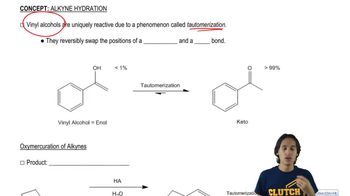
03:51
Vinyl alcohols yield tautomers.

Tautomerization

Tautomerization is a chemical reaction that involves the rearrangement of atoms within a molecule, resulting in the interconversion between two isomeric forms. In the case of vinyl alcohols, tautomerization leads to the formation of carbonyl compounds through a proton transfer and a shift of the double bond. This process is often facilitated by the presence of acids or bases, which can stabilize the transition state and promote the conversion.
추천 영상:
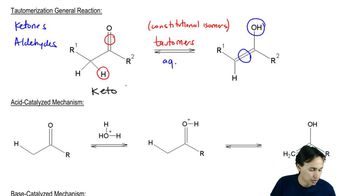
05:11
Tautomerization Mechanisms

Mechanisms of Isomerization

The mechanisms of isomerization describe the step-by-step processes by which one isomer transforms into another. For vinyl alcohols, the isomerization to carbonyl compounds can occur via an acid-catalyzed mechanism, where protonation of the hydroxyl group enhances the leaving ability of water, followed by a rearrangement to form the carbonyl. Understanding these mechanisms is crucial for predicting the behavior of vinyl alcohols in various chemical environments.
추천 영상:
06:47
Monosaccharides - D and L Isomerism
관련 실천
교과서 질문

Compound A (C7H11Br) is treated with magnesium in ether to give B (C7H11MgBr), which reacts violently with D2O to give 1-methylcyclohexene with a deuterium atom on the methyl group (C). Reaction of B with acetone (CH3COCH3) followed by hydrolysis gives D (C10H18O). Heating D with concentrated H2SO4 gives E (C10H16), which decolorizes two equivalents of Br2 to give F (C10H16Br4). E undergoes hydrogenation with excess H2 and a Pt catalyst to give isobutylcyclohexane. Determine the structures of compounds A through F, and show your reasoning throughout.

1198
views
교과서 질문

Vinyl alcohols are generally unstable, quickly isomerizing to carbonyl compounds. Propose mechanisms for the following isomerizations.

(c)

694
views
교과서 질문

Vinyl alcohols are generally unstable, quickly isomerizing to carbonyl compounds. Propose mechanisms for the following isomerizations.

(a)

2076
views
교과서 질문

Grignard reagents react slowly with oxetane to produce primary alcohols. Propose a mechanism for this reaction, and suggest why oxetane reacts with Grignard reagents even though most ethers do not.

750
views
교과서 질문

Geminal diols, or 1,1-diols, are usually unstable, spontaneously losing water to give carbonyl compounds. Therefore, geminal diols are regarded as hydrated forms of ketones and aldehydes. Propose a mechanism for the acid-catalyzed loss of water from propane-2,2-diol to give acetone.

3421
views
1
comments
교과서 질문

Show how you would synthesize the following compounds from any starting materials containing no more than six carbon atoms.

(b)

771
views