Ch.10 - Structure and Synthesis of Alcohols
Wade - Organic Chemistry 9th Edition
Wade9th EditionOrganic ChemistryISBN: 9780135213728당신이 사용하는 게 아니라요?교과서 변경
10장, 문제 36j

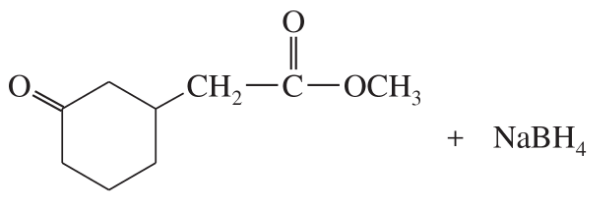
Draw the organic products you would expect to isolate from the following reactions (after hydrolysis).
(j)

검증된 단계별 안내
1
Step 1: Analyze the reactants. The molecule contains two carbonyl groups: a ketone group in the cyclohexane ring and an ester group in the side chain. Sodium borohydride (NaBH₄) is a reducing agent that selectively reduces ketones and aldehydes to alcohols but does not typically reduce esters under standard conditions.
Step 2: Predict the reduction of the ketone group. NaBH₄ will reduce the ketone group in the cyclohexane ring to a secondary alcohol. This involves the addition of a hydride ion (H⁻) to the carbonyl carbon, followed by protonation during hydrolysis.
Step 3: Consider the ester group. Since NaBH₄ does not reduce esters under standard conditions, the ester group will remain unchanged in the product.
Step 4: Hydrolysis step. After the reduction, hydrolysis ensures that any intermediate formed during the reaction is stabilized, and the alcohol group is fully formed.
Step 5: Draw the final product. The cyclohexane ring will now have a secondary alcohol group where the ketone was, while the ester group remains intact. The structure will include a hydroxyl group (-OH) on the cyclohexane ring and the unchanged ester group in the side chain.

비슷한 문제에 대한 검증된 영상 답변:

이 영상 해법은 위 문제에 도움이 된다고 튜터들이 추천한 것입니다.
영상 길이:
2m

주요 개념

질문에 올바르게 답하기 위해 반드시 이해해야 하는 핵심 개념들은 다음과 같습니다.

Hydrolysis

Hydrolysis is a chemical reaction involving the breaking of a bond in a molecule using water. In organic chemistry, it often refers to the conversion of esters, amides, or other functional groups into their corresponding acids and alcohols or amines. Understanding hydrolysis is crucial for predicting the products of reactions, especially when water is involved in the reaction mechanism.
추천 영상:
가이드 코스
1:00
Hydrolysis of Thioesters Concept 2

Reaction Mechanisms

A reaction mechanism is a step-by-step description of how a chemical reaction occurs, detailing the bond-breaking and bond-forming processes. In organic chemistry, mechanisms help predict the products of reactions by illustrating the movement of electrons and the formation of intermediates. Familiarity with common mechanisms, such as nucleophilic substitution or elimination, is essential for accurately determining the expected products.
추천 영상:
02:16
Heck Reaction Mechanism

Functional Groups

Functional groups are specific groups of atoms within molecules that are responsible for the characteristic chemical reactions of those molecules. In organic chemistry, recognizing functional groups such as alcohols, carboxylic acids, and amines is vital for predicting the behavior of compounds during reactions. The nature of the functional groups involved will significantly influence the products formed after hydrolysis.
추천 영상:
02:36
Identifying Functional Groups