Ch.10 - Structure and Synthesis of Alcohols
Wade - Organic Chemistry 9th Edition
Wade9th EditionOrganic ChemistryISBN: 9780135213728당신이 사용하는 게 아니라요?교과서 변경
10장, 문제 36n

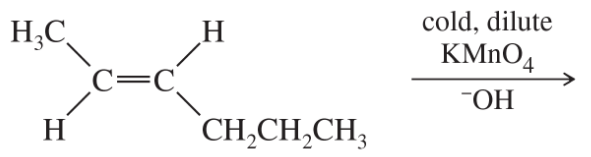
Draw the organic products you would expect to isolate from the following reactions (after hydrolysis).
(n)

검증된 단계별 안내
1
Step 1: Analyze the reaction conditions. The reagent KMnO₄ under cold, dilute conditions is used for the oxidation of alkenes to form diols (glycols) via syn-dihydroxylation. This reaction adds hydroxyl (-OH) groups to the double bond in a syn fashion.
Step 2: Identify the structure of the starting material. The molecule contains a double bond (C=C) in the structure, which is the reactive site for KMnO₄ under these conditions.
Step 3: Predict the product formation. The double bond will undergo syn-dihydroxylation, meaning two hydroxyl groups (-OH) will be added to the carbons involved in the double bond. The stereochemistry of the addition will be syn, meaning both hydroxyl groups will be added to the same face of the molecule.
Step 4: Draw the product structure. For the given alkene, add -OH groups to the two carbons of the double bond. Ensure the stereochemistry reflects syn addition (both -OH groups on the same side of the molecule).
Step 5: Verify the product. Confirm that the resulting molecule is a vicinal diol (two hydroxyl groups on adjacent carbons) and that no other functional groups or parts of the molecule are altered under these reaction conditions.

비슷한 문제에 대한 검증된 영상 답변:

이 영상 해법은 위 문제에 도움이 된다고 튜터들이 추천한 것입니다.
영상 길이:
2m
도움이 되었나요?

주요 개념

질문에 올바르게 답하기 위해 반드시 이해해야 하는 핵심 개념들은 다음과 같습니다.

Alkene Hydroxylation

Alkene hydroxylation is a chemical reaction where alkenes react with oxidizing agents, such as cold, dilute KMnO4, to form glycols. This reaction typically adds hydroxyl (-OH) groups across the double bond of the alkene, resulting in the formation of vicinal diols. Understanding this process is crucial for predicting the products of the given reaction.
추천 영상:
가이드 코스
2:09
Alkene Metathesis Concept 1

Regioselectivity

Regioselectivity refers to the preference of a chemical reaction to yield one structural isomer over others when multiple possibilities exist. In the case of alkene hydroxylation, the regioselectivity is influenced by the stability of the carbocation intermediates and steric factors, which can affect the distribution of products formed during the reaction.
추천 영상:
05:09
Heck Reaction

Stereochemistry of Products

Stereochemistry involves the spatial arrangement of atoms in molecules and how this affects their chemical properties. In the context of alkene reactions, the formation of diols can lead to different stereoisomers, such as cis and trans forms. Recognizing the stereochemical outcomes is essential for accurately depicting the products after hydrolysis.
추천 영상:
가이드 코스
1:38
Polymer Stereochemistry Concept 1