Ch.10 - Structure and Synthesis of Alcohols
Wade - Organic Chemistry 9th Edition
Wade9th EditionOrganic ChemistryISBN: 9780135213728당신이 사용하는 게 아니라요?교과서 변경
10장, 문제 56c

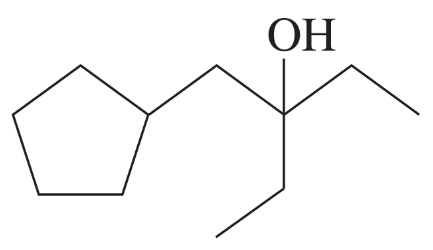
Often, compounds can be synthesized by more than one method. Show how this 3° alcohol can be made from the following:

(c) an ester

검증된 단계별 안내
1
Step 1: Identify the target molecule, which is a tertiary alcohol. The structure provided shows a 3° alcohol with a cyclopentyl group, a methyl group, and an ethyl group attached to the central carbon bearing the hydroxyl group.
Step 2: To synthesize this tertiary alcohol from an ester, consider the reaction mechanism. Esters can be reduced to alcohols using organometallic reagents such as Grignard reagents (RMgX) or organolithium reagents (RLi). These reagents add alkyl groups to the carbonyl carbon of the ester.
Step 3: Select an appropriate ester precursor. The ester should have a structure that allows the formation of the tertiary alcohol upon reaction with the organometallic reagent. For this molecule, the ester could be ethyl cyclopentylcarboxylate (cyclopentyl group attached to the carbonyl carbon and an ethyl group as the ester substituent).
Step 4: React the ester with a methyl Grignard reagent (CH₃MgBr) or methyl lithium (CH₃Li). The organometallic reagent will attack the carbonyl carbon of the ester, leading to the formation of a tertiary alcohol after hydrolysis.
Step 5: Perform the hydrolysis step. After the addition of the organometallic reagent, the intermediate formed is a tertiary alkoxide. Acidic workup (e.g., H₃O⁺) will protonate the alkoxide, yielding the desired tertiary alcohol.

비슷한 문제에 대한 검증된 영상 답변:

이 영상 해법은 위 문제에 도움이 된다고 튜터들이 추천한 것입니다.
영상 길이:
3m
도움이 되었나요?

주요 개념

질문에 올바르게 답하기 위해 반드시 이해해야 하는 핵심 개념들은 다음과 같습니다.

Alcohol Synthesis

Alcohols can be synthesized through various methods, including reduction of carbonyl compounds, hydrolysis of alkyl halides, and esterification reactions. Understanding the mechanisms of these reactions is crucial for determining how to convert other functional groups, such as esters, into alcohols.
추천 영상:
02:26
Forming alcohols through Oxymercuration-Reduction.

Ester Hydrolysis

Ester hydrolysis is a reaction where an ester reacts with water to form an alcohol and a carboxylic acid. This reaction can occur under acidic or basic conditions and is essential for converting esters into alcohols, particularly in the context of synthesizing a tertiary alcohol from an ester.
추천 영상:
가이드 코스
0:48
Hydrolysis of Phosphate Esters Concept 2

Tertiary Alcohols

Tertiary alcohols are characterized by having the hydroxyl (-OH) group attached to a carbon atom that is bonded to three other carbon atoms. Their synthesis often involves reactions that provide a stable carbocation intermediate, which is important when considering the pathways from esters to tertiary alcohols.
추천 영상:
가이드 코스
2:07
Tertiary Protein Structure Concept 1