Ch.10 - Structure and Synthesis of Alcohols
Wade - Organic Chemistry 9th Edition
Wade9th EditionOrganic ChemistryISBN: 9780135213728당신이 사용하는 게 아니라요?교과서 변경
10장, 문제 57a

Show how this 1° alcohol can be made from the following:
Structural formula of a 1° alcohol with a hydroxyl group and a five-membered carbon ring.
(a) a 1° alkyl bromide

검증된 단계별 안내
1
Step 1: Identify the target molecule, which is a primary alcohol (1° alcohol) with the structure cyclopentylmethanol. This molecule has a hydroxyl (-OH) group attached to a primary carbon that is directly bonded to a cyclopentyl group.
Step 2: Recognize that the starting material is a primary alkyl bromide. A suitable primary alkyl bromide for this synthesis would be cyclopentylmethyl bromide, where the bromine atom is attached to the same primary carbon as in the target alcohol.
Step 3: Plan the reaction mechanism. To convert a primary alkyl bromide to a primary alcohol, a nucleophilic substitution reaction (SN2 mechanism) can be used. In this reaction, the bromine atom is replaced by a hydroxyl group (-OH).
Step 4: Select the reagent for the substitution reaction. Sodium hydroxide (NaOH) or potassium hydroxide (KOH) in an aqueous solution can act as the nucleophile, providing the hydroxide ion (OH⁻) needed for the substitution.
Step 5: Write the reaction. Cyclopentylmethyl bromide reacts with hydroxide ion (OH⁻) in an SN2 reaction to produce cyclopentylmethanol and sodium bromide (NaBr) as a byproduct. Ensure the reaction conditions favor SN2, such as using a polar aprotic solvent if necessary.

비슷한 문제에 대한 검증된 영상 답변:

이 영상 해법은 위 문제에 도움이 된다고 튜터들이 추천한 것입니다.
영상 길이:
4m

주요 개념

질문에 올바르게 답하기 위해 반드시 이해해야 하는 핵심 개념들은 다음과 같습니다.

Nucleophilic Substitution

Nucleophilic substitution is a fundamental reaction in organic chemistry where a nucleophile replaces a leaving group in a molecule. In the case of converting a 1° alkyl bromide to a 1° alcohol, a nucleophile, typically hydroxide ion (OH-), attacks the carbon atom bonded to the bromine, displacing the bromine atom and forming the alcohol.
추천 영상:
01:47
Nucleophiles and Electrophiles can react in Substitution Reactions.

1° Alkyl Bromide

A 1° alkyl bromide is a type of organic compound where a bromine atom is attached to a primary carbon atom, which is connected to only one other carbon atom. This structure is significant because it influences the reactivity and mechanism of nucleophilic substitution reactions, often favoring the SN2 pathway due to less steric hindrance.
추천 영상:
가이드 코스
0:53
Peptide Sequencing: Partial Hydrolysis with Cyanogen Bromide Concept 1

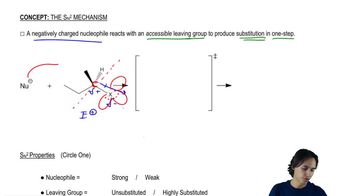
SN2 Mechanism

The SN2 mechanism (substitution nucleophilic bimolecular) is a type of nucleophilic substitution that involves a single concerted step where the nucleophile attacks the electrophilic carbon as the leaving group departs. This mechanism is characteristic of primary substrates like 1° alkyl bromides, leading to inversion of configuration at the carbon center.
추천 영상:
08:33
Drawing the SN2 Mechanism