Dimethylamine, (CH3)2NH, has a molecular weight of 45 and a boiling point of 7.4 °C. Trimethylamine, (CH3)3N, has a higher molecular weight (59) but a lower boiling point (3.5 °C). Explain this apparent discrepancy.
Ch.10 - Structure and Synthesis of Alcohols
10장, 문제 5
Predict which member of each pair will be more soluble in water. Explain the reasons for your answers.
(a) hexan-1-ol or cyclohexanol
(b) heptan-1-ol or 4-methylphenol
(c) 3-ethylhexan-3-ol or octan-2-ol
(d) hexan-2-ol or cyclooctane-1,4-diol
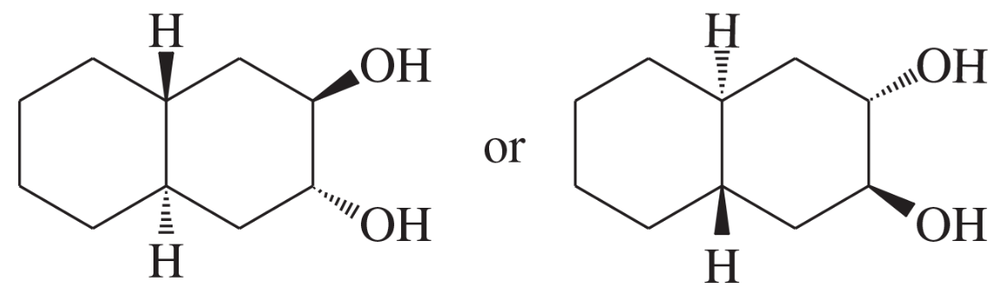
(e) 
검증된 단계별 안내1
Step 1: Solubility in water is influenced by the ability of a molecule to form hydrogen bonds with water. Molecules with polar functional groups, such as hydroxyl (-OH) groups, are more likely to form hydrogen bonds and thus are more soluble in water.
Step 2: For part (a), compare hexan-1-ol and cyclohexanol. Hexan-1-ol has a linear structure, while cyclohexanol is cyclic. The linear structure of hexan-1-ol allows for better interaction with water molecules, but cyclohexanol's compact structure may reduce solubility slightly. Both have one hydroxyl group, so solubility differences will be minor.
Step 3: For part (b), compare heptan-1-ol and 4-methylphenol. Heptan-1-ol has a single hydroxyl group on a linear chain, while 4-methylphenol has an aromatic ring with a hydroxyl group. The aromatic ring in 4-methylphenol contributes to hydrophobicity, making it less soluble in water compared to heptan-1-ol.
Step 4: For part (c), compare 3-ethylhexan-3-ol and octan-2-ol. Both molecules have hydroxyl groups, but 3-ethylhexan-3-ol has branching near the hydroxyl group, which can hinder hydrogen bonding with water. Octan-2-ol has a more linear structure, which may enhance its solubility in water.
Step 5: For part (d) and (e), compare hexan-2-ol and cyclooctane-1,4-diol, and the two structures in the image. Cyclooctane-1,4-diol has two hydroxyl groups, increasing its ability to form hydrogen bonds with water, making it more soluble than hexan-2-ol. Similarly, in part (e), the molecule with two hydroxyl groups will be more soluble in water due to increased hydrogen bonding compared to the molecule with no hydroxyl groups.

비슷한 문제에 대한 검증된 영상 답변:
이 영상 해법은 위 문제에 도움이 된다고 튜터들이 추천한 것입니다.
영상 길이:
7m주요 개념
질문에 올바르게 답하기 위해 반드시 이해해야 하는 핵심 개념들은 다음과 같습니다.
Polarity and Solubility
Polarity refers to the distribution of electrical charge over the atoms in a molecule. Polar molecules, which have a significant difference in electronegativity between atoms, tend to dissolve well in polar solvents like water. Understanding the polarity of the functional groups in the compounds, such as hydroxyl (-OH) groups, is crucial for predicting their solubility in water.
추천 영상:
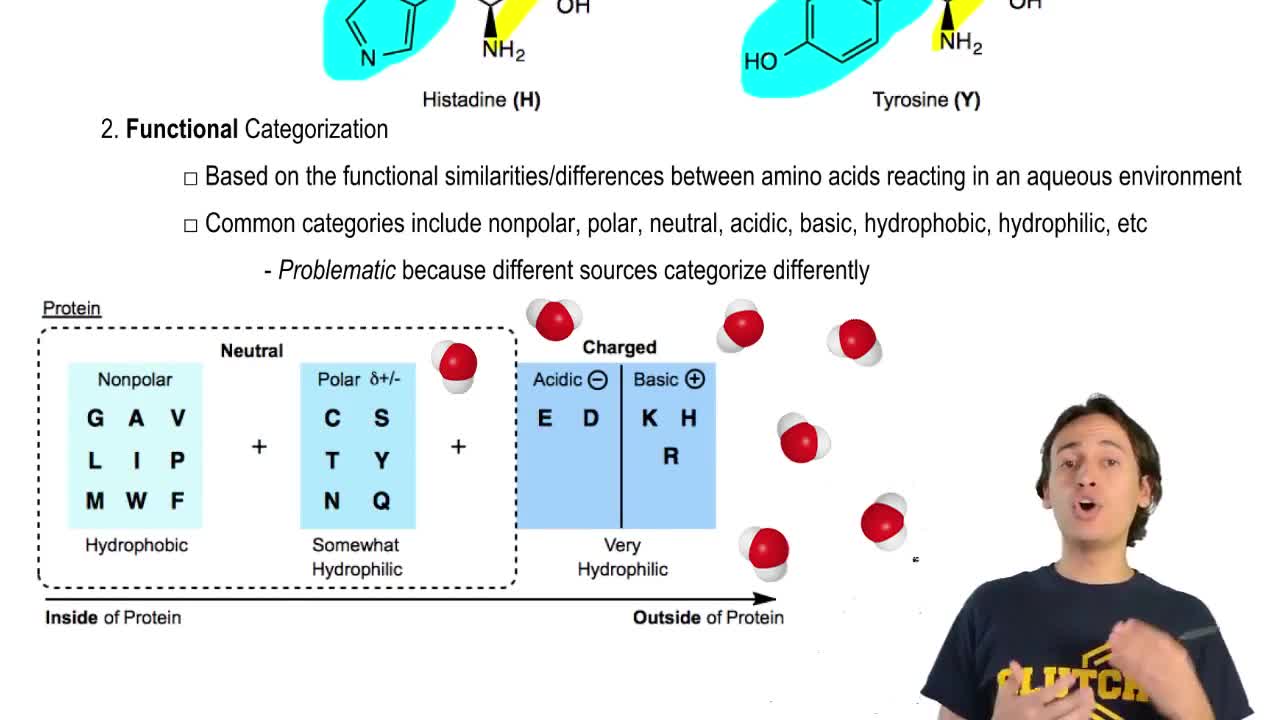
Functional Classification
Hydrogen Bonding
Hydrogen bonding is a type of intermolecular force that occurs when a hydrogen atom covalently bonded to a highly electronegative atom, like oxygen, interacts with another electronegative atom. Compounds with hydroxyl groups can form hydrogen bonds with water, enhancing their solubility. The ability to form these bonds is a key factor in determining which compound will be more soluble.
추천 영상:
The definition of hydrogenation.
Hydrophobic vs. Hydrophilic Interactions
Hydrophobic interactions occur between nonpolar molecules that do not interact favorably with water, while hydrophilic interactions involve polar molecules that can interact with water. In organic compounds, the presence of long hydrocarbon chains can make a molecule more hydrophobic, reducing its solubility in water. Understanding the balance between hydrophobic and hydrophilic parts of a molecule is essential for predicting solubility.
추천 영상:
가이드 코스
Interactions within the Tertiary Structure Concept 2
관련 실천
교과서 질문
1425
views
교과서 질문
For each molecular formula, draw all the possible constitutional isomers of alcohols with that formula. Give the IUPAC name for each alcohol.
(d) C3H4O
1434
views
교과서 질문
Predict which member of each pair will be more acidic. Explain your answers.
d. 2,2-dichloropropan-1-ol or 2,2-difluoropropan-1-ol
963
views
교과서 질문
Give a systematic (IUPAC) name for each diol
(d)
(e)
1149
views
교과서 질문
Give a systematic (IUPAC) name for each diol
(a) CH3CH(OH)(CH2)4CH(OH)C(CH3)3
(b) HO-(CH2)8-OH
(c)
1257
views
교과서 질문
Predict which member of each pair will be more acidic. Explain your answers.
c. 2-chloroethanol or 2,2-dichloroethanol
1159
views